Lead Generation for SaaS Startups That Actually Works
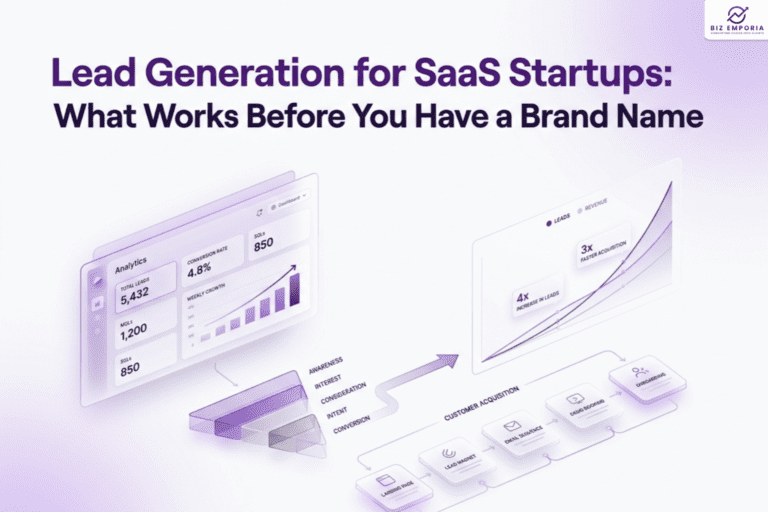
Lead Generation for SaaS Startups: What Works Before You Have a Brand Name
Most SaaS startups launch with a product that works and a pipeline that does not. The assumption, almost always unstated, is that a good enough solution finds its own audience. It does not. Not when funded competitors are bidding on the same keywords and your domain is four months old.
Lead generation for SaaS startups is a specific problem. The buyer is rarely one person. The sales cycle runs longer than founders expect. And the unit economics only make sense if the customer stays long enough to justify what acquisition cost.
What Makes Lead Generation for SaaS Startups Uniquely Challenging?
SaaS lead generation does not have one problem. It has several, and they build on each other. Long sales cycles. Multiple decision-makers. A product that has to be understood before it can be valued. A revenue model that requires retention to justify what acquisition cost. A bad-fit lead does not just fail to convert. It churns, damages metrics, and pulls support resources away from customers who actually belong there.
A SaaS startup with thirty customers cannot afford two of them to be wrong fits. At small scale, the damage is not proportionate. The startups that build real pipelines do 3 things differently: they have specific ideal customer profile, content built around questions that profile is already asking, and a conversion path that earns trust before it asks for a decision.
Which Channels Work Best for SaaS Lead Generation in the Early Stages?
For startups without brand recognition, the highest-returning channels are content marketing with SEO, LinkedIn outreach, community platforms, and email sequences built around free trial activation. Paid search works only once a landing page actually converts and the value proposition is sharp enough to justify cost per click.
Content and SEO take time, four to six months before rankings move meaningfully. The cost per lead once it is working is lower than almost anything else and does not stop when the budget does.
LinkedIn is where B2B buying decisions start. A founder posting consistently about the problem the product solves, with no pitch, just genuine perspective, builds an audience of exactly the right people. Paid LinkedIn lead gen forms reduce friction for demo requests considerably.
Community platforms are consistently underrated. A genuinely helpful answer in a niche Slack group or subreddit generates more qualified signups in a day than a week of paid spend. The catch is that it only works when the contribution is real.
How Does Content Marketing Drive Qualified Leads for SaaS Startups?
The buyer is already searching. They just do not know the product exists yet. SaaS content marketing works by getting in front of that search before the product ever enters the conversation. Comparison pages, use case articles, and integration guides pull buyers mid-research and move them toward a demo without a sales call being the first point of contact.
A procurement manager searching “how to reduce manual purchase order errors” has never heard of your product. But an article ranking for that query, one that answers it in full and links to a product page, brings that person to you through logic rather than ad spend.The content types worth building first are comparison pages, which capture buyers in evaluation mode, and vertical-specific landing pages, which outperform generic product pages in nearly every test.
How Should SaaS Startups Convert Free Trial Users into Paying Customers?
Trial conversion has one variable that matters above everything else. How fast the user gets to the moment where the product does what it was built to do. That moment is the activation point. Every touchpoint in the trial period, every email, every in-product prompt, every support message, exists to get the user there as quickly as possible. Trials that never reach activation almost never convert, regardless of how well the acquisition strategy performed.
This is the part of lead generation for SaaS startups that most marketing conversations skip because it sits at the border of product and marketing. But the conversion rate from trial to paid is as much a lead generation metric as cost per click. Fixing it does not require more traffic. It requires a better sequence.
A trial sequence that holds up in practice:
Day 1. The welcome email does one thing. It tells the user what to do first. Not five onboarding steps. Not a feature tour. One action that moves them toward activation.
Days 2 to 4. Behaviour-triggered emails. If the setup is incomplete, a prompt goes out. If the user has moved through core setup, the next message points to the feature that deepens the value they have already found. The sequence follows what the user has done, not a fixed calendar.
Day 8. A short, personal-feeling check-in. Not a newsletter. A message that reads as if a person wrote it, asking whether the product is doing what they need. The replies to this email, and there will be replies, are some of the best sales intelligence a startup can collect.
Days 13 to 15. The conversion nudge arrives before the trial ends. Not on expiry day. A case study from a company in the same industry, a time-limited offer, or a short video from the founder explaining what paid customers get. None of those outperforms a generic “your trial is ending” notification by a margin that is not close.
Conclusion: Pipeline Does Not Build Itself
The startups that figure out lead generation early share one trait. They did not wait for the product to ship before treating it as a core business function. Lead generation for SaaS startups is not one tactic. It is content that earns trust, channels that reach the right buyers, and a trial experience that converts rather than leaks.
If the current approach to lead generation for SaaS startups is producing noise instead of pipeline, BizEmporia builds digital marketing strategies for growth-stage businesses around measurable outcomes. Book a consultation and get a direct assessment of what is not working and what would.
FAQ: Lead Generation for SaaS Startups
Q: How long does content marketing take to generate leads for a SaaS startup?
A: Four to six months before organic traffic moves consistently. Six to twelve months before it becomes a meaningful source of qualified leads. Run outbound or paid in parallel while content builds.
Q: Is paid advertising worth it for an early-stage SaaS startup?
A: Only if the landing page converts and the offer is specific. Paid traffic to a vague page is a budget, leaving the account with nothing to show for it.
Q: What lead magnet works best for SaaS?
A: Calculators, audit tools, and templates tied to the problem the software solves. They attract people who want the product, not just the content.
Q: Should SaaS startups focus on inbound or outbound first?
A: Both, with different expectations. Outbound surfaces real feedback on messaging within weeks. Inbound builds a lower-cost pipeline over time. Running only one is a choice with real consequences.