Open rates and reply rates get analyzed endlessly. The emails that never receive a response are usually forgotten. That’s often where the real problem lies. Too many sequences are built around what the sender wants to communicate rather than what the prospect actually wants to read.
One sequence booked 40 calls in 30 days. It wasn’t driven by clever copy or flashy subject lines. The emails were clear and relevant. What made them effective was the thinking behind each touchpoint and the discipline to stop before the sequence became repetitive. Seven emails. Eighteen days. One ICP. No purchased lists.
A cold email sequence for B2B leads works when each message earns the next one. Does not earn a reply. Earns the next open. Most sequences are built backwards. People write the emails first, then figure out the timing. That gets it wrong. The timing tells you what the email needs to do. Email one does not exist to get a reply. It exists to make email two feel expected rather than intrusive.
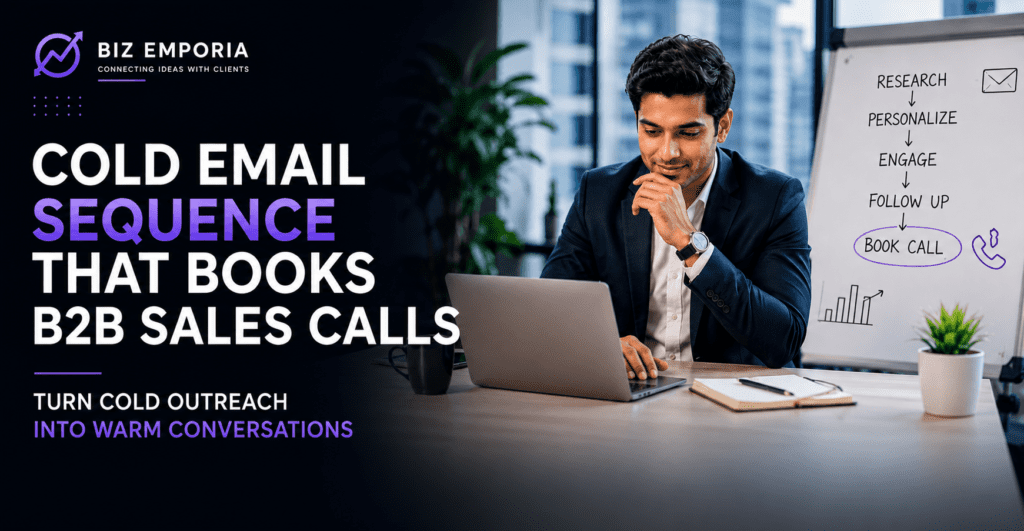
The 40-call sequence ran across seven touchpoints. Every email had a single job.
Day Sent | Job | |
Email 1 | Day 1 | Create a pattern interrupt |
Email 2 | Day 3 | Drop value, ask nothing |
Email 3 | Day 6 | Social proof, no pressure |
Email 4 | Day 9 | Name their actual problem |
Email 5 | Day 12 | Ask for the call |
Email 6 | Day 15 | Give them a clean exit |
Email 7 | Day 18 | Leave something useful, go quiet |
No “just following up.” No “bumping this to the top of your inbox.” Each email assumed the prospect had seen the previous one and was still deciding whether the conversation deserved any more of their attention. Every follow up moved that decision forward instead of restarting it.
The subject line and the first sentence together have one job: make ignoring this email feel like a mistake.
That sounds dramatic. It is also accurate. Most B2B inboxes are processed in under three seconds per email. If the preview text does not catch something, the email is gone. Subject lines from this sequence that consistently pulled opens:
Short. Specific. Slightly unfinished. They referenced something real about the prospect’s actual business, not a generic role or industry.
The first email body followed a three-part structure, and it stayed under 80 words every time:
One specific observation. A recent post they published, a job listing that signalled something, a product page that had a clear gap. Something that required actually looking at their business.
One sentence connecting it to the sender. Why does that observation matter given what the sender does? One line. Not a paragraph.
One soft question. Not “can we hop on a call?” Not a Calendly link. Just: “Does this sound like something worth a quick chat?”
That is the full email. No company history. No list of services. No “I came across your profile and was really impressed by what you are building.”
Because the first email almost never books the call. The sequence does. Most replies in this campaign came from emails three, four, and five. Not one. That is worth sitting with for a moment because it changes how you should think about follow-up. The first email is not supposed to close anything. It is supposed to make the follow-ups feel reasonable.
Where most email outreach to book sales calls breaks down is in how follow-ups are treated. Either they are carbon copies of email one with “just checking in” tacked on, or they swing the opposite way and become increasingly desperate by email three.
This sequence did neither. Every follow-up email brought something the previous one did not:
Email 2, Day 3. No ask at all. A relevant resource, a stat, a short case study relevant to their specific industry. Two sentences and a link. The subtext was: I am paying attention to your world, not just trying to get something from you.
Email 3, Day 6. A one-paragraph story about a company in a similar situation. Not a testimonial. A story with a before, a turning point, and a result. Named the company type, named a real number, kept it under 100 words.
Email 4, Day 9. The reframe. This email did not mention the sender’s services. It named a problem the ICP consistently runs into, described it in the language the prospect would use internally, and asked whether that was something they were dealing with right now. That question got replies on its own.
By email five, the prospect has had four low-pressure touchpoints. The ones who are going to be interested are interested. Now you ask.
The ask email for this sequence was the shortest one in the entire campaign. Forty-three words:
“Would a 20-minute call this week or next make sense? I can walk through exactly how we would approach [their specific challenge]. If the timing is off, no problem at all. Happy to stay in touch for when it makes more sense.”
First, asking for 20 minutes feels manageable. It is a specific, low commitment request, not another vaguely defined “discovery call” or “strategy session.” Second, the option to decline has to feel genuine. A simple “No problem at all” shows respect for the prospect’s decision and removes unnecessary pressure. That often makes people more willing to engage.
What this email did not include:
The break-up email is one of the most misunderstood tools in cold outreach. Most people write it to manufacture urgency. That is not what it is for.
Email six existed to give the prospect a genuinely clean exit. The exact text:
“I do not want to keep showing up if the timing is off. If this is not a fit right now, no hard feelings at all. Just let me know and I will leave you alone. If things change down the line, I am easy to find.”
That email had the second-highest reply rate of the entire sequence. Some of those replies were “not right now but let us reconnect in Q3.” Several of those became calls later. A few said yes immediately.
The final email, day eighteen, went only to people who had not replied to anything. No ask. Just one genuinely useful resource relevant to their role, with a note that said: “Leaving this here in case it helps. Nothing to reply to.”
That is how you leave a door open. Not with a passive-aggressive “I will take your silence as a no.” Just a clean, useful send and then silence.
The list had 420 contacts. All built manually. LinkedIn, company websites, industry directories. Every contact was verified before the sequence launched.
Metric | Result |
Total prospects in sequence | 420 |
Total emails sent across all 7 steps | ~1,800 |
Average open rate across the sequence | 52% |
Overall reply rate | 14% |
Positive or interested replies | 58 |
Calls booked | 40 |
Calls that moved to a proposal | 22 |
Reply rates around 14% are uncommon in cold B2B outreach. For most well managed campaigns, a response rate between 5% and 8% is generally considered a strong benchmark. The difference here was list quality. These 420 people were not scraped. They were selected. Every single one matched the ICP on at least four dimensions before they received email one.
A cold email sequence for B2B leads is only as good as the thinking that happened before the first email was written.
Bizemporia builds outbound systems for B2B brands that need consistent pipeline, not occasional wins. If the sequence structure above sounds like something your team needs help building, start here.
Seven is a reasonable ceiling for most B2B contexts. Below five and you are leaving replies on the table because most positive responses come mid-sequence. Above eight and you start to look like you have no other pipeline. The number matters less than the logic: every email needs a reason to exist beyond “I have not heard back yet.”
Tuesday, Wednesday, and Thursday between 8 AM and 10 AM in the prospect’s timezone consistently outperform other windows. That said, these patterns shift depending on the industry and seniority level. C-suite contacts at larger companies often open emails earlier and later than mid-level buyers. Test and adjust rather than treating any benchmark as fixed.
Research the first email manually. The observation in email one should be specific to that company. After that, personalisation tokens for name and company handle the mechanical work. The real signal of genuine personalisation is not how many fields you fill in. It is whether the hook in email one could have been sent to anyone or only to them.
ICP tightness. A list of 400 contacts who match your criteria across industry, company size, job title, and current growth stage will produce better results than 4,000 contacts who roughly fit. Email verification matters too. A bounce rate above 3% hurts sender reputation and reduces deliverability for the entire campaign.
Instantly, Smartlead, and Lemlist are commonly used for volume-based B2B sequences. For smaller outreach, a manually managed Gmail setup with a spreadsheet tracker works fine. The tool is secondary. What actually drives results is domain health: warmed-up sending addresses, correct SPF and DKIM records, and daily send limits that do not trigger spam filters.