How Search Is Changing From Google Results to AI Answers
The old sequence was simple enough that nobody thought twice about it. You had a question, you typed it into Google, ten links came back, and you clicked the one that looked most useful.
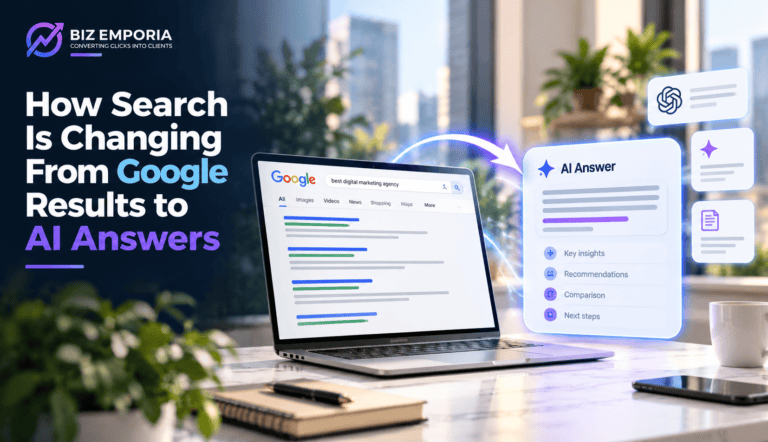
That sequence is cracking. Not gone, cracking. More and more often the person with a question opens ChatGPT or Perplexity instead, or even just stays on Google and reads the AI Overview sitting at the top of the page, and gets an answer handed to them before a single link enters the picture. The question’s answered. The site that used to supply that answer doesn’t get a click.
If your business built its visibility around the assumption that ranking on Google equals getting found, this is worth sitting with for a minute before it shows up as an unexplained dip in your traffic chart three months from now.
What Does SEO Full Form in Digital Marketing Actually Mean Today?
Anyone who’s spent even a week studying digital marketing has already bumped into the seo full form in digital marketing: Search Engine Optimisation. Making a website visible, and ideally rankable, on search engines. Mostly Google, let’s be honest.
For about two decades, knowing the seo full form in digital marketing was basically the same as knowing how Google’s algorithm behaved. Backlinks mattered. Keywords mattered. Site speed, mobile friendliness, technical health, all of it circled one question: what does Google want to see before it puts this page above a competitor’s?
None of that is wrong in 2026, to be clear. Google’s still the biggest search engine on the planet by a wide margin, and ranking well there still sends real traffic. But the definition people learned a decade ago is now missing a piece. The seo full form in digital marketing has quietly stretched to include what a lot of practitioners are calling Answer Engine Optimisation, or Generative Engine Optimisation if you prefer the other label, both of which are less about climbing a ranked list and more about getting mentioned by name when an AI system decides what to say.
Understanding that expansion is probably step one for any business trying to hold its ground, let alone grow, in the current environment.
How the Shift From Google Results to AI Answers Actually Plays Out
Try this. Open Perplexity and type something like “what’s the best project management software for a remote engineering team of 15 people.” You won’t get ten ranked links. You’ll get a written answer, pulled together from several sources at once, with a recommendation sitting right inside the text. Sources might get footnoted somewhere down the page. Most people never bother scrolling down to check them.
Google’s own AI Overviews do almost the same thing now. Plenty of searches that used to hand back a plain list of results now show an AI-written summary sitting above everything else on the page. The organic results haven’t disappeared, they’re just below an answer the user’s already read.
That’s the actual shift happening here. The results page used to be where you arrived. Increasingly, it’s just the launchpad for an answer that’s already been written by the time you get there.
And this is exactly why it hurts even sites with strong rankings. A page sitting comfortably in positions one through five for a keyword that matters can watch its traffic slide while the ranking itself barely moves. Nine times out of ten, that’s because an AI Overview is intercepting the click before it ever happens.
The pages feeling this most are the informational ones, the kind answering “what is X” or “how does Y work” or “best Z for this situation.” Those are the easiest for an AI system to summarise on the spot, no visit required.
Transactional and local pages get off lighter. If someone actually needs to book something, buy something, or find a business nearby, they still have to land on the site to finish the job. Working out which of your pages fall into which camp is honestly the first useful thing to do before panicking about any of this.
What the Data Is Actually Showing, Industry by Industry
Not every sector is getting hit at the same pace.
Category | AI Overview Impact | Why |
Informational queries (“what is,” “how does”) | High | AI can answer fully with no click needed |
Comparison queries (“X vs Y”) | Medium to high | AI handles comparisons well |
Local searches (“near me,” specific city) | Low | Needs real-time location data |
Transactional queries (“buy,” “book,” “hire”) | Low to medium | User still has to act on a specific site |
Brand searches (company name) | Low | User’s already looking for that one thing |
B2B research queries (complex, multi-stage) | Growing | AI’s taking over early research steps |
If your spend on seo services is weighted toward informational blog content, you’re probably already seeing the effect of this somewhere in your numbers. If most of your traffic comes from transactional or local searches, the hit is smaller for now, though buyer research habits are shifting across the board regardless of category.
How Do AI Systems Decide What Makes the Cut?
Why does one brand show up in an AI-generated answer while a competitor doesn’t? It comes down to how these systems form a picture of a brand’s authority in the first place.
Google’s ranking factors are at least partly public and partly reverse-engineerable. AI systems work differently, pulling from a much wider pool of signals, not just what a company says about itself on its own site, but what the rest of the internet says about it too.
A few things that feed into that picture: content on the brand’s own site written in a way that’s easy to lift as a direct answer. Mentions and reviews scattered across relevant industry publications. Coverage on analyst or research platforms, G2 and Capterra being the obvious ones in B2B. Conversation happening in forums, subreddits, and professional communities where the brand’s name actually comes up. And social posts from real people, founders, practitioners, who are publicly associated with the company.
A brand that keeps showing up consistently across those places, described the same way each time, gives an AI system enough of a signal to confidently include it in an answer. A brand that only exists on its own website, with almost nothing said about it anywhere else, might still rank fine on Google through solid seo services, and still be essentially invisible the moment someone asks an AI instead.
What This Means If You’re Running B2B Digital Marketing Services
If your pipeline leans on b2b digital marketing services to pull leads through search, this shift genuinely deserves a second look at where that budget is actually going.
Start with three questions. First, which pages are most exposed to AI Overview absorption? Informational pages carry the most risk here. Transactional pages carry less, at least for now. Second, does your brand actually show up in AI-generated answers for the exact questions your buyers are asking? You can’t guess at this, you have to go type the questions yourself into ChatGPT, Perplexity, and Google’s AI Overview and watch what comes back. Third, what would it realistically take to get mentioned in those answers? That’s where the real work begins, usually some combination of rewriting content to be more extractable, building authority off-site, and occasionally paid placement in whatever AI advertising formats are becoming available.
None of this replaces the seo services work keeping your Google rankings healthy. It sits alongside it, aimed at a channel that’s quietly eating into search intent Google used to have mostly to itself.
Where to Actually Start
The businesses handling this well aren’t the ones who predicted it years ago. They’re the ones who noticed fast enough to adjust before the traffic gap turned into a real problem.
Three things to do this week, honestly. Run the manual test, type ten questions your ideal buyer would actually ask ChatGPT or Perplexity, and see whether your name comes up anywhere in the answers. Pull your Search Console data and check click-through rate on your best-ranking informational pages, if the ranking’s steady but CTR is sliding, that’s about as clear a signal as you’ll get that an AI Overview is eating the click. And sort your pages into informational versus transactional, then prioritise conversion work on the transactional ones, since they’re the ones holding up better against all this for now.
That’s enough to build a real picture of where you stand, without blowing up your entire strategy before you’ve even confirmed there’s a problem.
Conclusion
The seo full form in digital marketing hasn’t changed. It’s still Search Engine Optimisation, and it still matters. What’s changed is the world seo services now operates in. Search intent that used to flow straight from Google’s results page to a website is increasingly getting swallowed by an AI-generated answer sitting above those results, or replacing them outright.
Businesses that notice this and adjust, keeping visibility in both the old search results and the new AI answers, are going to be in a stronger spot than the ones still pouring everything into a results page a growing share of their buyers never actually scroll down to anymore. None of this requires reinventing anything. It just requires actually looking at what’s happening and reacting to it.
If you want a clear read on where your business stands against this shift, and what adjusting your b2b digital marketing services approach would actually involve, BizEmporia runs AI visibility audits and search strategy reviews for businesses across India, UAE, UK, and international markets. Book a consultation through the website.
frequently Asked Questions
It's Search Engine Optimisation, same as it's always been. What's changed is the scope. Good search visibility in 2026 means optimising for Google's algorithm and for how AI systems pick what to cite when they generate an answer. The fundamentals haven't moved. The playing field around them has.
Depends heavily on query type and industry, there's no single number. Informational searches in crowded categories are losing the most clicks. Transactional and local searches are holding up better. A falling click-through rate on a page with a stable ranking is usually the first sign something's shifted.
No, and anyone telling you to drop it entirely is overreacting. Google's still where most search traffic lives, and ranking well still produces real leads. The right move is additive, keep the traditional SEO work going while also building the signals that get you noticed by AI systems. Dropping SEO now, before AI visibility infrastructure exists to replace it, just means losing traffic for nothing.
Anyone leaning heavily on informational search, content sites, education businesses, research-driven B2B companies, publishers, is feeling it first and hardest. Businesses built around local search, transactional queries, or branded search are seeing less of an immediate hit, though the way buyers research in general is shifting for everyone eventually.
By hand, there's no shortcut tool worth trusting yet. Open ChatGPT, Perplexity, and Google with AI Overviews turned on. Ask the ten questions your ideal buyer would genuinely ask while researching your category. See if you show up, and notice how you're described when you do. Takes under an hour and tells you more than any analytics dashboard currently can.