
How HVAC Companies Can Use Digital Marketing to Generate More Leads and Bookings
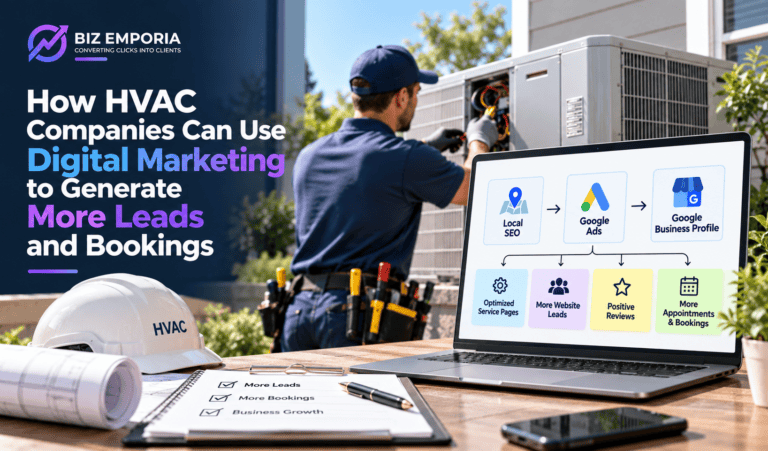
The HVAC company that shows up first when a boiler dies at 7pm on a Wednesday gets the job. It isn’t the one with the most experience or the longest history. It’s whoever appears in the search results with enough reviews to look trustworthy.
Most owners know this. Then you look at their Google Business Profile and it has 14 reviews. The website hasn’t had real work done in three years. The owner spends half the week chasing referrals, because nothing in the marketing sends enquiries in without someone pushing it.
Digital marketing for HVAC isn’t complicated. It does need someone to treat it as a proper part of the business instead of a job for quiet weeks. It also has to account for the fact that emergency callouts, annual servicing and new installations are three separate jobs sold to three different kinds of people.
Three Buyers, One Business
Most marketing speaks to one of these buyers and ignores the other two.
When a boiler breaks down, people often search for “boiler breakdown Leeds” or “emergency HVAC repair near me”. They usually call one of the first companies they find with good reviews. They don’t have time to compare lots of options because they need someone to help them as soon as possible.
The planned service buyer wants an annual boiler service, a gas safety certificate or a maintenance contract. They take their time and compare prices. They’re also the ones most likely to stay with you for years if the first visit goes well.
The installation buyer is spending serious money and takes days or weeks over it. They want proof you can do the job, a few case studies, and a quote process that feels credible. Nobody rings on impulse for a new boiler.
One ad budget and one landing page can’t serve all three. A digital marketing agency for HVAC company work has to plan for each of them separately. If it doesn’t, you end up with something that suits one buyer and loses the other two.
Google Business Profile Comes First
Search “HVAC engineer near me” or “heating company Manchester” and the local pack appears before the normal results. Three or four businesses, with ratings and phone numbers. It pulls in a big share of emergency and commercial searches, and it runs mostly off your Google Business Profile.
Most HVAC firms set theirs up once and never went back. A complete profile with 60 or more recent reviews, regular posts and a full service list will beat a rival with a nicer website and a neglected profile. A stranger deciding who to ring looks at the profile long before they see your site. If the last post is from two years ago and half the reviews sit unanswered, they’ll wonder whether you’re still trading.
A good profile has:
- A service list that separates emergency, maintenance and installation clearly
- At least 50 reviews, with something new in the last 30 days
- Photos of your actual team on actual jobs, no stock images
- Regular posts about seasonal work and useful tips
- A reply to every review, good or bad, within 48 hours
Separate Pages for Separate Situations
On the website side, digital marketing for HVAC means building a page for each service and each area, based on what people really search.
Someone searching “emergency boiler repair Manchester” has a cold house and no patience. The page has to load fast, put the phone number above the fold and confirm you cover their area straight away. Give them eight seconds of doubt and they’re gone.
“Annual boiler service Leeds” is a calmer search. That page needs pricing guidance, online booking, and answers to the things a planned buyer wants to know before they commit.
“New boiler installation quote Birmingham” needs case studies, the brands you fit, finance options and a simple way to ask for a quote.
Cramming all three onto one service page is the most common structural mistake on HVAC sites. Dedicated pages outperform it every time.
Google Ads Pays Back Fastest
Paid search returns money quickest in digital marketing for HVAC. The searches are specific and the intent is high. Somebody typing “emergency heating engineer Bristol” isn’t researching anything. They’re about to spend money.
Four campaigns are worth running:
Campaign | Target Queries | Landing Page | Main CTA |
Emergency callout | Emergency repair, breakdown, urgent | Emergency page, phone number dominant | Call now |
Annual service | Boiler service, gas safety, maintenance | Service booking page | Book online |
New installation | New boiler quote, replacement cost | Installation page with case studies | Get a quote |
Commercial HVAC | Office heating, commercial maintenance | Commercial page with SLA details | Request survey |
Each one needs its own bids, its own ad copy and its own landing page. Running all four from a single campaign is the top reason HVAC ad accounts disappoint. The intent differs, the route to a conversion differs, and mixing them together means none of them works properly.
Email and Text for Customers You Already Have
The cheapest job any HVAC company wins is a repeat one. Someone who had their boiler serviced last year and heard nothing since will search again with no particular loyalty. They might book whoever emailed them first.
A simple retention routine closes that gap:
- An annual service reminder at 11 months, by email and text
- A winter prep message every October to all residential customers
- An offer of emergency cover or a maintenance contract after any repair
- A yearly check-in with commercial clients, with a service review on offer
The annual reminder alone usually wins back 30 to 40 percent of past customers. For a firm with an established customer base, that often beats every other channel put together.
Treat Reviews Like an Asset
Reviews are among the most valuable things an HVAC firm owns, and one of the least looked after.
People check them before they ring. A profile with 12 reviews and nothing recent looks very different from one with 75, 15 of them from last month. Volume and recency count for as much as the star rating.
What works in practice is simple. Text the customer within four hours of finishing the job. Send a direct link to the Google review page instead of asking them to go find it. Mention the specific job in the message. Follow up once if they haven’t replied after five days, and answer every review within 48 hours. Run that on every completed job and the profile builds month by month. Every other channel gets easier too, because the trust is visible before anyone picks up the phone.
When to Hand It to an Agency
Knowing what works is the easy bit. Building it properly, tracking it and tuning it every week is harder. Owners who run their own marketing all hit the same wall. Checking ad performance, adjusting bids, reading search term reports, updating landing pages and analysing conversions all take time that should be going into the business. So things get set up well and then touched up now and then.
Here’s what to look for in a digital marketing agency for HVAC company work.
HVAC experience, specifically. General local business experience doesn’t count. Seasonal swings, the three buyer types, call tracking and landing page design for emergency versus planned work are all particular to this trade. You want an agency that has already solved those problems for other HVAC clients, not one learning on your budget.
Campaigns built around intent. If the proposal suggests one campaign for every HVAC service, the agency either misses the intent differences or prefers its own convenience over your results. Expect separate campaigns for emergency, service and installation at minimum.
Call tracking. Most HVAC leads arrive by phone. A digital marketing agency for HVAC company work that only counts form fills sees a fraction of the leads and optimises on bad data.
Reports that show money. Cost per qualified lead by channel. If the report opens with impressions and reach, the agency is measuring what’s easy.
Dedicated landing pages. Sending ad traffic to the homepage is the single biggest reason HVAC campaigns underperform. Each campaign needs its own page, built for that buyer.
Some warning signs:
- No HVAC case studies with real, named results
- Emergency, service and installation all lumped into one ad group
- No mention of call tracking or negative keywords
- Guaranteed lead numbers or rankings, which nobody can honestly promise
- A long minimum contract with no performance visibility and no exit clause
- Reports full of social engagement and reach instead of leads and cost per lead
A sensible engagement with a digital marketing agency for HVAC company clients runs in three stages. Month one is groundwork: website audit, GBP brief, conversion and call tracking, keyword research, a negative keyword list and landing page builds. Very little ad spend goes out until the tracking checks out. Months two and three are launch. Campaigns go live, search term reports get reviewed weekly, call quality feedback comes back in, and landing page conversion rates are tracked. You’ll get leads at this stage, though not yet at a good cost. From month four, the real optimisation starts, with seasonal bid changes, ad copy tests and cost per lead settling at something predictable. By then the return should show in the numbers.
Conclusion
Digital marketing for HVAC companies works when the pieces connect. Local SEO gives you a base. Google Ads brings in enquiries quickly. Reviews build the trust that makes everything else convert. Retention campaigns stop past customers drifting to rivals.
A digital marketing agency for HVAC company owners can rely on will know how HVAC buyers behave, how demand swings with the seasons, and how emergency, service and installation enquiries each convert. That beats a generalist running a standard local service template.
Biz Emporia helps HVAC and home service businesses attract relevant enquiries through planned, ongoing digital marketing. If you want to spend less time chasing leads and build a more consistent flow of potential customers, visit the website to book a consultation.
frequently Asked Questions
Google Business Profile and Google Ads together for immediate lead generation, local SEO for long-term organic pipeline, and email or SMS retention for repeat bookings from the existing client base. The priority depends on whether the business needs leads immediately or is building sustainable growth, and most benefit from all three running as a system.
Google Ads produces enquiries within days of a well-structured campaign going live. GBP improvements show within four to six weeks. Local SEO producing consistent organic enquiries takes three to six months in competitive local markets. Email retention campaigns produce results from the first send to an established list.
More than the nearest competitor in the same service category and geographic area. Volume and recency both matter. A business with 80 reviews, 20 of which are from the last 30 days, consistently outperforms a competitor with a higher average rating but fewer and older reviews. Building review volume systematically is as commercially important as the service delivery that earns them.
A phone number that is impossible to miss on mobile, service area confirmation within the first screen, visible recent reviews, and separate landing areas for emergency, service, and installation buyers. A single homepage trying to serve all three buyer types simultaneously serves none of them as well as dedicated pages would.
For companies generating above a certain revenue threshold, typically £200,000 or more annually, the return on professional marketing management almost always exceeds the management cost within six months. Below that threshold, a combination of optimised GBP, systematic review generation, and a well-structured Google Ads campaign can be partially managed in-house with periodic professional support rather than a full retainer.