
When AI Recommends Your Competitor: 5 Reasons Your Brand Gets Left Out of AI Search
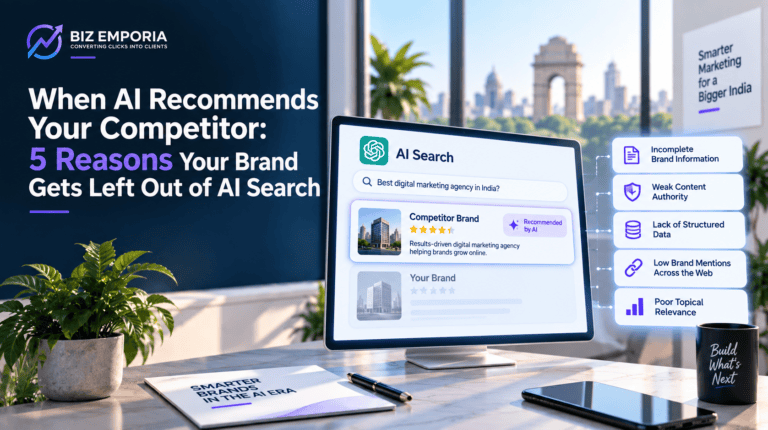
It is a specific kind of frustration. You type the question your buyer would ask into ChatGPT. A reasoned, detailed response comes back recommending three companies in your category. Your brand is not one of them. One of the three you know well. Another you have been outselling for two years. The third you have barely heard of.
Your SEO is doing fine. Your Google rankings haven’t changed. The website looks good too. But when a potential customer turns to AI search to find companies in your category, your brand isn’t mentioned. The frustrating part is that your usual numbers may not show you there’s a problem. Traffic can look normal, and rankings can stay steady because the person who got their answer from ChatGPT never had a reason to visit your website. That’s where the AI search visibility gap starts to show.
Here are the five most common reasons brands get left out of AI-generated recommendations, and what to do about each one.
Reason 1: Your Content Answers Topics, Not Questions
AI systems extract answers. They do not rank pages. When a user asks ChatGPT which project management tool works for a distributed engineering team, the model scans indexed content for the specific answer to that specific question. Content that covers project management broadly, with paragraphs about features, use cases, and integrations woven into a general narrative, is content the model reads and finds nothing cleanly extractable from.
Your competitor whose page opens with “Built for distributed engineering teams managing multiple concurrent projects” and follows with a direct description of exactly how it addresses that situation gets cited. Your page covering every possible use case for every possible team type gets passed over.
The fix is not adding more content. It is restructuring what exists.
Start with the question your customer wants answered, and put the answer near the top of the section. There’s no need to spend two paragraphs setting the scene before getting to it. The explanation and supporting evidence can follow. When the answer is clear and easy to find, it also gives AI systems something more useful to extract.
Start with the ten pages that matter most to your business. Read each one and ask: if a potential customer asked ChatGPT the question this page is meant to answer, would the answer appear within the first two sentences? Usually, it won’t. Bringing the key answer forward is one practical way to address that AI search visibility gap.
Reason 2: The Brand Has No Voice in the Sources AI Trusts
AI models do not build their understanding of a brand from the brand’s own website alone. They build it from everything indexed across the web that mentions, describes, or evaluates the brand. Reviews, industry publications, analyst reports, forum discussions, community platforms, comparison sites, media coverage. The composite picture from all of those sources is what the AI uses when deciding whether to include a brand in a recommendation.
If the brand’s presence outside its own website is thin, the AI’s picture of the brand is thin. A competitor mentioned specifically in three industry publications, featured on two analyst comparison lists, and discussed in community forums where their target buyers spend time, exists in the AI’s understanding as a real, credible, contextualised option. A brand that appears only on its own website and a few generic directories exists as a name with almost no surrounding context.
For GEO for brands, off-site authority building is not optional. It is the layer that tells AI systems that the brand is real, relevant, and trusted by sources beyond itself.
The sources worth building presence in, specifically for AI indexing purposes: relevant industry publications that cover the category in depth, review platforms like G2 or Capterra for software categories, analyst and research outputs where the category is discussed, LinkedIn content from named practitioners at the company who speak specifically about the problems the brand solves, and niche community platforms where target buyers ask each other for recommendations.
Every mention in these sources needs to be specific enough to be useful. A generic brand mention carries less weight than a mention that names the brand, describes what it does, who it serves, and what outcome it produces. The specificity is the signal. Generic mentions accumulate without building meaningful AI understanding.
Reason 3: The Brand Description Is Inconsistent Across the Web
An AI model building a picture of a brand from multiple sources encounters a problem when those sources say different things. The website says “revenue operations platform for B2B SaaS companies.” The G2 profile says “sales automation software.” The press release says “the leading CRM for growing teams.” The LinkedIn page says “AI-powered go-to-market platform.”
Four different descriptions. Four different categories. Four different implied buyer types. The AI tries to synthesise these into a coherent understanding and ends up with something vague, or it defaults to the competitor whose brand description is consistent everywhere.
AI brand recommendations work better when the brand is described clearly and consistently across different sources. If the website, profiles and other mentions tell different stories about what the company does, the AI may have trouble understanding where the brand fits.
Fixing this requires an audit of every source where the brand is described. Not just the website. The Google Business Profile, the LinkedIn company page, G2 and other review platforms, every directory listing, every press release still indexed, every about-page description. The description on all of them should say the same thing in the same terms about the same customer and the same outcome.
The core description should be written once, specifically, and updated consistently everywhere. “A B2B SaaS platform that helps mid-sized logistics companies reduce manual reporting time by automating pipeline data across their existing tools” is a description that AI can extract, use, and cite accurately. “An innovative solution for modern businesses” is not.
Reason 4: No Specific, Attributable Proof Points Anywhere on the Site
Claims without evidence are not citable. An AI model generating a recommendation needs something specific to attach to the brand. A number, a named outcome, a specific type of customer, a concrete result. Without specifics, the brand appears in AI-indexed content as a name with a general purpose and no differentiation.
Often, the difference comes down to whether there is something specific to say about the competitor. A claim such as “Reduces onboarding time by 60 percent for SaaS companies under 200 employees” gives AI something concrete to work with. So does “Used by over 400 logistics firms across Southeast Asia.” “Rated 4.8 on G2 by operations teams specifically.” Each of those is a specific, attributable claim that an AI model can extract and use in a recommendation.
Vague claims are invisible to AI extraction. “We help businesses grow.” “Industry-leading results.” “Trusted by hundreds of clients.” These exist on too many websites in too many categories to carry any meaning in AI-generated responses.
For AI search visibility, the website needs specific proof points on every page that matters. Case study numbers, not case study feelings. Named outcomes, not implied benefits. Specific customer types and sizes, not “businesses of all sizes.” The specificity test is simple: can this sentence be cited accurately in a recommendation without distorting its meaning? If not, it needs to be made more specific.
Reason 5: The Brand Has Not Been Active in the Conversations AI Learns From
AI models are not static archives. They are continuously updated from current, indexed content. Brands that were producing specific, useful, well-structured content twelve months ago and stopped are less present in current AI responses than brands actively contributing new content, new mentions, and new community presence right now.
This is a different dynamic from traditional SEO where old content with strong backlinks can rank indefinitely. In AI search, recency and ongoing presence matter because the model’s training and index updates favour current information over historical content on questions about which brand to use today.
GEO for brands is an ongoing function, not a one-time project. The brands consistently being recommended by AI systems are not the ones that did a content audit eighteen months ago. They are the ones producing new specific content regularly, maintaining active presence in relevant community discussions, generating fresh review and testimonial content that updates their profile on review platforms, and earning new mentions in current publications.
The practical question is not “how do we build AI visibility” as a project. It is “what does the ongoing activity look like that maintains AI visibility as a function.” Publishing cadence, community participation, review generation, earned media, and fresh case study content are the recurring activities that keep a brand present in AI-indexed content rather than fading into historical context.
The Compound Effect of Getting All Five Right
Each of the five reasons above costs brands individually. Missing one reduces AI search visibility in specific, measurable ways. Missing all five compounds the problem until the brand is effectively absent from AI-generated recommendations in its category, which becomes more expensive to fix the longer it continues.
The brands appearing consistently in AI recommendations in competitive categories are not usually there by accident. They have specific content that answers specific questions. They have presence in the sources AI trusts. Their brand description is consistent. Their proof points are citable. They are active in the conversations AI learns from. Each of those things was built deliberately and none of them happened overnight.
The gap between where a brand is now and where it needs to be for consistent AI brand recommendations is closeable. The sequence matters more than the speed. Content structure first because it is within the brand’s direct control and the changes produce results quickly. Off-site authority and consistency work next because it takes more time to build and cannot be rushed. Ongoing activity last because it is maintenance rather than construction but it is the maintenance that keeps everything else working.
BizEmporia builds AI search visibility through GEO and LLM Ads strategies for brands across India, UAE, UK, and international markets. If your competitors are showing up in AI-generated recommendations while your brand isn’t, an AI visibility audit is a useful place to start. It can help identify where your visibility is falling short and what may be contributing to the gap. Book through the website or write to info@bizemporia.in.
frequently Asked Questions
Test it directly. Write out ten questions your target buyer would realistically type into ChatGPT or Perplexity when researching your category. Run each one. See whether your brand appears, and if it does, in what context and with what accuracy. Do the same on Gemini. The results tell you more about your AI search visibility than any analytics dashboard currently available. Run the same test every month to track movement.
Content structure changes, rewriting to put answers first and making claims specific, can start influencing AI citation patterns within four to eight weeks. Off-site authority building takes longer, typically three to six months before the compound effect of new mentions, updated profiles, and fresh content shifts how AI models understand the brand. The changes are not linear. Brands often see a step-change improvement rather than a gradual slope when enough signals align.
Less than most people assume. AI systems weight specificity and contextual relevance more heavily than brand scale. A mid-sized company with highly specific, well-structured content and consistent off-site presence in relevant sources will appear in AI recommendations ahead of a large competitor whose content is broad, inconsistent, and generic. The playing field is not equal but it is considerably more level in AI search than in traditional search, which makes the investment in GEO for brands disproportionately valuable for companies that are not the category leader by size.
The two should run alongside each other rather than one replacing the other. Traditional SEO captures buyers who are searching with known keywords on Google. AI search visibility captures buyers who are describing a situation to an AI and asking for a recommendation. These are different buyers at different stages of the research process. A brand that invests in both reaches buyers at more points in the journey than one that focuses exclusively on either.
There is no mechanism for requesting removal of a competitor from AI-generated answers. The answer to a competitor appearing when you do not is to build the signals that make your brand appear alongside them or instead of them. Specific content, consistent brand description, credible off-site presence, specific proof points, ongoing activity. The AI system is not making editorial choices about who to favour. It is responding to signals. Build stronger signals than the competitor and the recommendations shift over time.