
SEO in 2026: Why Ranking Number One Doesn't Guarantee Traffic
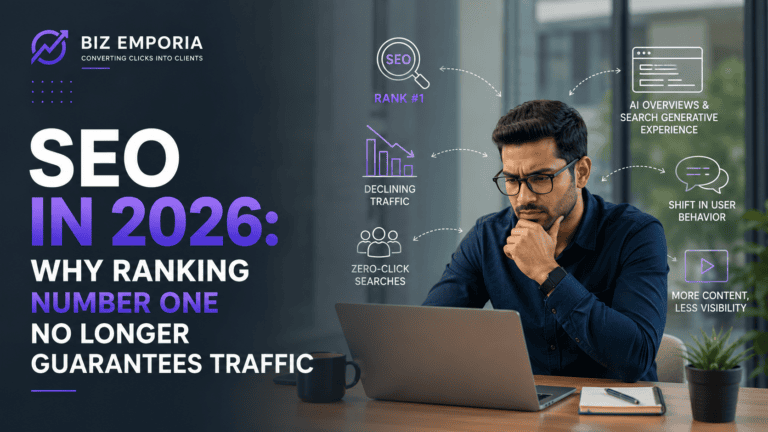
SEO in 2026: Why Ranking #1 No Longer Guarantees Traffic (GEO Explained)
Here is a situation that is becoming uncomfortably common.
A brand ranks on the first page of Google. Has ranked there for years. Traffic was stable, predictable, something the team had learned to rely on. Then, somewhere around late 2025, something changed. Rankings did not drop. The position in search results stayed exactly where it had always been. But organic traffic started falling month after month. No penalty. No algorithm hit. Nothing that a standard SEO audit could identify as the problem.
The traffic was being intercepted before it ever reached the website. Google’s AI Overview was sitting at the very top of the results page and answering the question completely without the need to scroll down or click further.
The brand was ranking. The brand was not getting the traffic. This shift defines SEO 2026. Businesses adapting successfully are no longer measuring success by rankings alone. Instead, they are focusing on whether their content is being cited by AI systems, because that is increasingly what determines visibility.
What Has Actually Changed in Search and Why Does a Strong Content Strategy No Longer Guarantee Traffic?
Google has shifted from returning ranked pages to generating synthesised answers. A content strategy built for ranking alone is now partially invisible to users who get their answer from AI Overviews without clicking through to any website.
For the better part of two decades, the SEO equation was relatively stable. Produce good content, earn authoritative backlinks, optimise the technical fundamentals, rank for the right keywords, and traffic follows. The relationship between position in search results and website visits was reliable enough that entire business models were built around it.
That relationship has changed in a specific and measurable way.
AI Overviews now appear at the top of the results page for a growing proportion of searches. Commercial queries, informational queries, comparison queries, how-to queries. The user sees a synthesised answer before they see any organic result. For queries where the AI Overview fully addresses the question, a meaningful percentage of users never scroll past it.
The pages sitting at positions one through five below that AI Overview are still ranking. They are just not getting clicked.
What this means for any content strategy built around traditional ranking logic:
- Pages that answer informational questions well are the most exposed. They rank because they are good at answering questions. AI Overviews cite them and answer the same questions without requiring a click.
- Click-through rates on informational content have declined across virtually every category where AI Overviews are active.
- The brands seeing the steepest drops are the ones whose content strategy was built entirely around informational keywords. Exactly the content type AI Overviews are most capable of replacing.
A content strategy that does not account for this shift is not just less effective than it was two years ago. In some cases it is actively counterproductive. It produces content that feeds Google’s AI product while generating diminishing returns for the brand that created it.
What Is GEO and How Is It Different From the Content Strategy You Already Have?
GEO stands for Generative Engine Optimisation. It is the discipline of structuring content to be cited by AI systems when generating answers. Traditional SEO optimises for ranking. GEO optimises for citation. The way content is structured, the level of detail it provides, and the way success is measured all change with GEO.
Traditional SEO asks, “How do I rank for this search?”
GEO asks, “How do I become the source AI chooses to cite?”
A content strategy focused only on rankings is no longer enough in SEO 2026.
AI systems do not read content the way humans do. They extract. They scan for content that makes a specific, attributable, verifiable claim and then cite it. The content that gets extracted and cited consistently has three characteristics that a standard content strategy rarely optimises for.
It answers the user’s question immediately. Content that gives a clear answer in the opening sentence, followed by supporting evidence, is more likely to be cited than content that takes several paragraphs to reach the point.
It makes specific, verifiable claims rather than general assertions. “Customers report improved efficiency” is not citable. “A 340-person logistics company reduced monthly reporting time from 14 hours to 3 hours within the first quarter of implementation by replacing manual data consolidation with automated pipeline triggers” is citable. The specificity is what gets extracted.
It is structured so that the answer and its supporting evidence are separable from the surrounding narrative. AI systems extract fragments, not full pages. AI systems extract short passages, not entire articles. The clearer and more self-contained a section is, the more likely it is to be cited. Building a content strategy for GEO means writing every section so that it delivers a complete, evidence-backed answer on its own.
What Does E-E-A-T Mean in Practice for a B2B Brand’s Content Strategy?
E-E-A-T stands for Experience, Expertise, Authoritativeness, and Trustworthiness. It means Google now evaluates if the person writing about a topic has experienced it, or not. A content strategy built on agency-written, keyword-optimised articles is being devalued in 2026.
E-E-A-T is discussed in almost every SEO conversation but it isn’t implemented correctly.
The practical shift is this. Google’s algorithm has become significantly better at distinguishing between content written by someone who has lived through a problem and content assembled by someone who researched it from published sources and repackaged it. The signals are subtle but consistent. The specificity of observations. The presence of edge cases. The kind of detail that only emerges from direct involvement with the subject matter.
For a B2B SaaS brand, the distinction looks like this in practice. A product manager who has spent two years watching enterprise customers fail to adopt a software tool, and who writes about the specific organisational dynamics that cause adoption failure, is producing content that cannot be replicated by a content agency. The observations are real. The specificity is real. The experience signal is real.
A content agency writing “10 reasons enterprise software adoption fails” by synthesising existing research is producing content that looks similar on the surface and carries almost no E-E-A-T signal in 2026.
The content strategy implication is significant. Getting practitioners in front of content production, product managers, engineers, customer success leads, founders, not as bylines on agency-written pieces but as actual authors writing from actual experience, is the structural shift that E-E-A-T rewards. It is harder to execute than outsourcing content production. The output is categorically different in how Google and AI systems treat it.
Which Pages Should Be Optimised for AI Citation and Which Should Be Excluded?
Pages where citation builds brand awareness or demonstrates capability should be optimised for GEO. Pages where the conversion depends on the user actually arriving, such as deep implementation guides, pricing pages, and competitive comparisons, should be protected from AI extraction using nosnippet or max-snippet directives.
This is the strategic decision most content strategy conversations are skipping entirely. And it is the one with the most direct revenue impact.
Not all AI Overview appearances benefit the business. For brands where content serves as a funnel entry point, where the goal is a demo request, a consultation booking, or a download, an AI Overview appearance on that content absorbs user intent before it reaches the website.
Here is the decision framework that makes this clearer:
Page Type | CTR Trend After AI Overview | Conversion Role | Recommended Action |
Feature and product pages | Stable | Brand awareness | Optimise for GEO citation |
Practitioner thought leadership | Stable or improving | Authority building | Optimise for GEO citation |
Category definition content | Stable | Awareness | Optimise for GEO citation |
Integration documentation | High citation volume | Buyer research | Optimise for GEO citation |
Deep implementation guides | Declining | Funnel entry | Apply nosnippet directive |
Competitive comparison pages | Declining | Direct conversion | Apply nosnippet directive |
Pricing and packaging pages | Any trend | Direct conversion | Apply nosnippet directive |
A real example of why this matters. In a B2B SaaS audit conducted earlier this year, a brand had a library of thirty-one detailed implementation guides that had historically driven significant demo request traffic. The guides were comprehensive and well written. They were being cited in AI Overviews extensively. Demo request traffic from those pages had dropped by over 60% in five months.
The fix involved two decisions. Applying nosnippet directives to the guides, and restructuring them to include a gated component, specifically a downloadable implementation checklist that required an email address before download. The guides remained rankable in traditional search. They stopped feeding AI Overviews. Click-through rates partially recovered within two months. The conversion rate on arriving visitors improved because the users clicking through were more motivated than the casual researchers the AI Overview had previously intercepted.
The content strategy lesson here is important. Visibility in AI Overviews is not inherently good. It is good when the business benefits from the citation. It is damaging when the citation replaces the visit that was supposed to start the conversion.
What Content Types Win GEO Citations Consistently?
Outcome-specific case studies with precise metrics, category definition content that clearly explains what a product does and how it differs from alternatives, and integration documentation with specific technical detail are the three content types most consistently cited by AI systems.
The content strategy that generates reliable AI citations looks meaningfully different from the content strategy that generated reliable rankings three years ago.
Outcome documentation with real specificity. The case study that says a customer “improved operational efficiency” is not extractable. The case study that names the company size, the specific process that changed, the specific metric that moved, and the timeframe in which it happened gets extracted repeatedly. Every case study in a GEO-oriented content strategy should be written to include these specifics, even when clients prefer vaguer language about their results.
Category definition content. If a brand is the source that most clearly and specifically defines what its product category does, how it differs from adjacent categories, and what problems it solves, AI systems draw on that definition repeatedly. This is one of the most durable GEO assets available. Owning the definition of a category in AI-generated answers is worth more than ranking for the category keyword.
Integration and implementation specificity. Buyers ask AI systems specific implementation questions constantly. “Does this platform integrate with Salesforce” gets asked thousands of times a month across AI search tools. The brands that answer those questions specifically, not “yes we integrate with Salesforce” but “our Salesforce integration syncs opportunity stage changes in real time with configurable field mapping that does not require developer involvement,” get cited when buyers ask those questions.
Practitioner-authored thought leadership. When an AI cites a specific observation made by a named practitioner at a named company, that citation builds brand recognition independently of whether the user clicks through. A CPO’s specific observation about enterprise data governance, cited in an AI answer, builds credibility with a buyer who never visited the website. The content strategy implication: practitioner-authored content earns citation value that ghost-written or agency-written content simply does not.
How Should International Brands Adapt Their Content Strategy for GEO Across Multiple Markets?
AI systems in different markets draw from different sources, respond to different query patterns, and weight different authority signals. A content strategy built for one market’s GEO requirements will not perform consistently across geographies without deliberate localisation at the content, source, and entity level.
Operating across India, UAE, UK, and North America introduces specific complexity that a single global content strategy cannot resolve on its own.
The AI tools that dominate search vary by market. Google AI Overviews are dominant in India and the UK. Perplexity has significant traction in the US enterprise buyer segment. ChatGPT’s browsing function is used heavily by technical decision-makers globally. A content strategy built entirely around Google’s extraction logic is missing a portion of AI-mediated research in international markets, particularly at the enterprise level.
The authority sources AI systems trust also vary considerably. G2 and Gartner carry weight in Western enterprise markets. In India, references from domestic practitioner communities and local analyst voices influence AI citation patterns differently. A GEO content strategy needs off-site presence built in the sources that AI systems in each specific market actually draw from, not just the sources that matter in the home market.
Query patterns differ fundamentally across geographies. A buyer in India researching enterprise software asks different questions, uses different terminology, and carries different contextual concerns than a buyer in the UK doing the same evaluation. A content strategy written for one market’s query patterns will underperform in another regardless of how well the content ranks technically.
What Is the Practical Audit That Tells You Where Your Content Strategy Actually Stands?
Pull click-through rate data for your top organic pages from Google Search Console, test those pages’ primary queries with AI Overviews enabled, and map each declining-CTR page to its conversion role. That map tells you which pages to optimise for GEO and which to protect from AI extraction.
The audit runs in four steps.
Step one: Identify which pages are currently appearing in AI Overviews by testing the most important queries in Google with AI Overviews enabled in a fresh browser session. Note which pages are being cited and what the AI is saying about them.
Step two: For each page appearing in an AI Overview, pull the last six months of click-through rate data from Google Search Console. Compare the trend before and after the AI Overview began appearing. A page with stable rankings and declining CTR is a page where the AI is absorbing the intent.
Step three: Map each affected page to its conversion role. Is this page an entry point to a funnel? Does it drive a specific action such as a form fill, a download, or a demo request? Or is it purely educational content where the brand benefits from being cited even without a click?
Step four: Make the exclusion or optimisation decision based on that mapping. Not based on a blanket policy. Not based on a general preference for or against AI Overviews. Based on whether the page’s value to the business depends on the user arriving, or whether citation alone serves the content strategy goal.
This audit takes a few hours for a moderately sized website. The decisions it produces are among the highest-leverage content strategy interventions available in 2026. Almost nobody is running it systematically.
The Compounding Advantage
One thing about GEO that most brands consistently underestimate: AI citation compounds over time.
A brand that is consistently cited as an authoritative source on a specific topic gets cited more as time goes on. AI systems learn from patterns of citation. The brand’s human readers share, link to, and reference content that AI has already validated as authoritative. The off-site signals that matter for E-E-A-T grow as a direct result of the citations themselves.
The brands building this asset now, while most competitors are still optimising for ranking positions that AI Overviews are absorbing, will be significantly harder to displace twelve months from now.
The window to build a cited, authoritative, AI-visible presence before a category becomes crowded is open. It will not stay open at the same cost indefinitely.
Working With Biz Emporia on SEO and GEO Strategy
At Biz Emporia, we conduct SEO and GEO audits for brands operating across India, UAE, UK, Europe, and international markets. We identify where a content strategy is being absorbed by AI Overviews, which pages need GEO optimisation, and which pages need protection from AI extraction before that extraction costs the business pipeline it cannot see disappearing.
If your organic traffic is declining despite stable rankings, the answer is almost certainly in the AI Overview data. The intervention is more specific than it might appear from the outside.
Visit bizemporia.in or write to info@bizemporia.in to start that conversation.
frequently Asked Questions
SEO optimises content to rank in search results. GEO optimizes content to be cited by AI systems when they generate answers. A page can rank well in traditional search and still lose traffic to an AI Overview that answers the same question without requiring a click. In 2026, a content strategy that only accounts for ranking is addressing half the visibility problem.
AI Overviews are intercepting the click before it happens. When Google's AI generates a complete answer at the top of the results page, a portion of users get what they need without scrolling to the organic results below. The page is still ranking. The user just never reaches it. Declining click-through rate alongside stable ranking position is the clearest signal that an AI Overview is absorbing the traffic.
No. For informational content where brand visibility is the goal, citation in an AI Overview builds awareness even without a click. For pages where the business value depends on the user actually arriving, such as demo request pages, competitive comparisons, or deep implementation guides, an AI Overview appearance absorbs the intent before it converts. The decision to optimise for or protect against AI extraction depends entirely on what the page is supposed to do.
AI systems and Google's ranking logic both weight content from people with direct, demonstrable experience on the subject more heavily than content assembled from secondary research. A product manager writing from two years of direct customer observation produces a stronger E-E-A-T signal than an agency-written article covering the same topic. In practical terms, getting practitioners involved in content production rather than using them only as bylines is the structural change that E-E-A-T rewards most consistently.
Pull click-through rate data for your top organic pages from Google Search Console and look for pages where CTR is declining while ranking position is stable. Then test those pages' primary queries in Google with AI Overviews enabled in a fresh browser session. Pages appearing in AI Overviews with falling CTR are the ones to address first, either by optimising for GEO citation or by applying nosnippet directives depending on the page's conversion role.