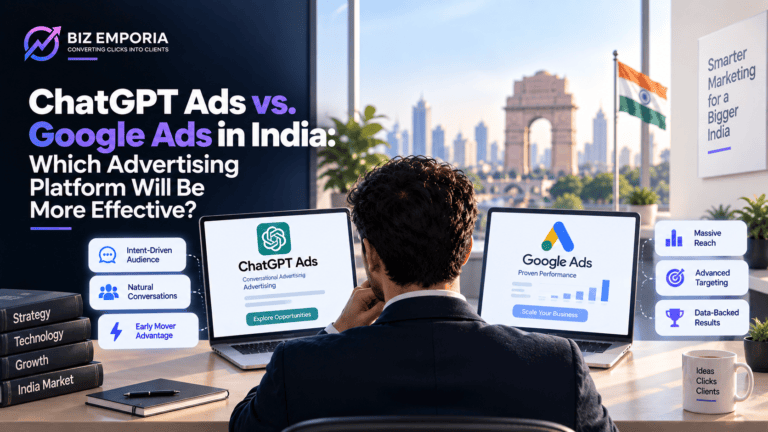
ChatGPT Ads vs. Google Ads in India: Which Advertising Platform Will Be More Effective?
Every few years, something shows up in digital advertising that forces an actual rethink. Not a new feature bolted onto an existing platform. A genuinely different way of reaching a buyer altogether.
ChatGPT Ads vs Google Ads is exactly that conversation right now, and it’s really a question about AI advertising India as a whole versus the search-based model Indian marketers have relied on for two decades. Indian businesses that have run Google Ads for years are wondering whether ChatGPT’s format deserves a line in the budget. Businesses that never quite made Google Ads economics work for them are wondering if this new channel is finally the one that does.
The honest answer is that these two platforms aren’t competing for the same moment in the buyer’s journey at all. Understanding where each one actually fits matters more than crowning a winner.
How Google Ads Works and Why Indian Businesses Have Relied on It
Google Ads has been the default intent-based advertising channel for Indian businesses for close to two decades now. The reason’s simple enough. When someone in India opens Google and types a search, they’re telling the platform exactly what they want. Google Ads puts a relevant business in front of that person right at that moment.
The model works because search intent is genuinely real. Someone typing “chartered accountant in Hyderabad” isn’t browsing idly. They want a specific service, right now. Google Ads India places the right business in front of them at the exact instant they’re ready to engage.
What’s actually changed is the cost of that moment. Google Ads in India has gotten noticeably more expensive across competitive categories over the last five years. Legal services, education, real estate, software, and financial products: cost per click in these spaces has climbed to a point where the economics get genuinely hard for smaller businesses and startups. The inventory’s crowded. Auctions are fierce. Brands with the deepest pockets end up setting the floor price everyone else has to pay too.
Beyond the cost, there’s a structural gap that’s always existed but is getting harder to ignore. Google Ads captures people who are already searching. It doesn’t reach people still in the research phase, before they even know what to search for. That earlier stretch of the buyer’s journey, where someone’s still figuring out what they actually need, has always been a blind spot Google Ads never really filled, and it’s the core reason the ChatGPT Ads vs Google Ads comparison exists at all.
How ChatGPT Ads Work, and What Actually Makes Them Different
ChatGPT Ads vs Google Ads isn’t a comparison of two versions of the same idea. The mechanisms underneath genuinely differ, and understanding that gap is really the whole point of evaluating ChatGPT advertising in India as its own channel rather than a Google Ads substitute.
When someone opens ChatGPT, they describe a situation rather than typing a keyword. “I’m starting a food business in Chennai, I need to understand what registrations I need and which CA firm could help me with compliance.” That’s not a search query. It’s a brief. The user hands the AI a full picture of their problem and asks for a reasoned response back.
ChatGPT Ads show up inside that response. When the situation matches what an advertiser has targeted, a clearly labelled sponsored recommendation appears as part of the actual answer. It isn’t sitting separately from the content the user came for. It’s woven right into it, relevant to the exact situation described, and the user is already reading it because they’re reading the response itself.
Three things about this format genuinely matter commercially.
Intent is explicit, not inferred. Google guesses at what a keyword means. ChatGPT reads what the user actually wrote, in full. An advertiser on ChatGPT knows the user’s whole situation, not just a fragment of a query. That’s a fundamentally different quality of targeting signal.
The user is engaged, not scanning. On a Google results page, someone scans several options at once, and the ad competes against nine other results for attention. Inside a ChatGPT response, they’re reading. The sponsored recommendation sits inside content being actively consumed, not alongside content being evaluated and compared.
The channel is genuinely new. The number of Indian advertisers running ChatGPT Ads vs Google Ads campaigns isn’t remotely comparable yet. Google Ads India has thousands of active advertisers fighting over the same categories. ChatGPT advertising in India sits at a fraction of that competition level right now, and AI advertising India more broadly is still finding its feet. Costs stay low the way any underutilised inventory does before demand finally catches up to it.
The Head-to-Head Comparison
Factor | Google Ads | ChatGPT Ads |
User intent signal | Keyword inferred | Full situation described |
Ad format | Text link or display unit | Native recommendation in response |
User attention state | Scanning multiple options | Reading a single response |
Competition in India | High and rising | Early stage, low competition |
Cost per click | High in competitive categories | Currently low |
Buyer journey stage | Decision stage, ready to search | Research stage, defining the problem |
Measurement maturity | Fully developed | Early stage, evolving |
Best for | Capturing existing demand | Creating and capturing emerging demand |
Setup complexity | Established, well-documented | Newer, less standardised |
Creative format | Short headline and description | Longer, contextual recommendation |
The buyer journey row deserves the most attention here, honestly. Google Ads captures people who’ve already decided they need something and are actively searching for a provider. ChatGPT Ads reach people who are still working out what they need, using an AI to think the problem through in the first place.
Those are two different moments entirely. Both are genuinely valuable. Neither one substitutes for the other.
Where Google Ads Still Wins in India
A few specific situations where Google Ads India remains the stronger pick:
- High-volume local search: A plumber in Ahmedabad, a restaurant in Connaught Place, a driving school in Pune. These carry immediate local intent; the buyer knows exactly what they want and just needs to find it nearby. Google’s local infrastructure, Business Profile listings, and location-based targeting handle this better than anything competing right now.
- Categories with established search habits: Insurance, flights, banking products, job listings. Indian buyers have been trained on Google specifically for these, and that volume of established behaviour isn’t yet replicated on ChatGPT.
- Short decision cycles: When the gap between searching and buying is small, Google Ads captures that moment efficiently. Someone searching for a courier service needs one today, and ChatGPT isn’t where they’re going to find it; the query’s simply too transactional for a conversational interface.
- Retargeting: Retargeting remains an area where Google has a clear advantage, with a mature system that works across the web and provides established measurement. ChatGPT does not yet offer a similar mechanism for bringing previously engaged users back.
Where ChatGPT Ads Win in India
Just as clearly, there are situations where ChatGPT Ads vs Google Ads tips firmly toward the newer platform.
High-consideration B2B purchases- A business owner researching ERP software, a founder looking for a legal partner ahead of fundraising, a logistics company evaluating a new TMS, these are buyers working through a genuinely complex decision. They’re not typing a two-word query into Google. They’re describing their situation to ChatGPT and asking for a reasoned answer back. Being the recommendation in that exact moment carries enormous value.
Categories where buyers don’t know the right terminology yet- Plenty of Indian businesses selling professional services run into buyers who simply don’t know what to call the thing they need. A startup wanting to give equity to early employees might never think to search “ESOP structuring advice.” They’ll ask ChatGPT instead: “I want to give equity to my early employees, how do I do that legally in India?” The right firm showing up in that response reaches someone who’d never have found them through a keyword search at all.
Early-stage category building- ChatGPT Ads can help businesses in emerging categories where Google search demand is still limited, allowing Indian buyers to discover what the business offers by describing a problem instead of searching for a specific term.
Buyers who use ChatGPT as their primary research tool- This segment is growing fast in India, particularly among urban professionals, founders, and decision-makers under 40. For businesses targeting these exact profiles, the audience is already substantial on ChatGPT, and the competition for their attention through this channel is close to nothing.
So Which Is the Best Advertising Platform in India?
The ChatGPT Ads vs Google Ads question doesn’t really have a single winner, and businesses hunting for the best advertising platform in India are asking the wrong question entirely.
Google Ads is a demand capture tool. It reaches buyers who’ve already decided they need something and are actively hunting for a provider. The investment pays off where existing search demand already exists for whatever the business offers.
ChatGPT Ads is a demand creation and capture tool operating earlier in the buyer’s journey. It reaches people still defining their problem, still looking for help thinking through their options. The investment pays off when the buyer’s still in research mode and the business wants to be the recommendation they get before they’ve even narrowed down their search.
The strongest advertising strategies for Indian businesses in 2026 run both platforms together. Google Ads India captures the buyer who’s ready to search right now. ChatGPT Ads reaches that same buyer two weeks earlier, while they’re still figuring out what they even need. Both investments genuinely pay out, just at different points along the buyer’s timeline, and both deserve to be measured that way rather than judged against each other directly.
The businesses best positioned twelve months from now are the ones building ChatGPT advertising capability today, while the channel’s still early and costs are still low, without walking away from Google Ads wherever it’s still producing return.
If your business is trying to work out the right mix of ChatGPT Ads vs Google Ads for the Indian market, Biz Emporia works with businesses across India, UAE, UK, and international markets to build advertising strategies across both platforms. Start with a free AI visibility audit to see where your brand currently stands in ChatGPT responses before deciding where to actually invest. Book through the website or write to info@bizemporia.in.
frequently Asked Questions
Not as a wholesale switch. Treat ChatGPT Ads as an additional investment rather than a reallocation, at least for now. Google Ads still produces returns in most categories because it captures existing search demand, while ChatGPT Ads reach buyers earlier in the journey. Keep both budgets separate and judge each against its own success criteria rather than pitting them against one another.
Intent quality on ChatGPT tends to run higher for complex B2B categories, simply because the buyer describes their full situation instead of typing a short query. A B2B software company getting leads through ChatGPT Ads is getting inquiries from people who've already laid out their specific problem in detail, arriving with more context and less qualification work needed. That's not a knock on Google Ads leads; it just means ChatGPT tends to reach buyers who are further along in their own thinking.
Google Ads has a fully mature measurement framework: clicks, impressions, conversion rate, cost per acquisition. ChatGPT Ads measurement is still evolving but already covers impressions, clicks, and downstream conversion tracking. On top of that, AI share of voice- how often a brand shows up in ChatGPT responses for relevant buyer queries- is a metric that simply doesn't exist in Google Ads reporting and needs its own tracking setup. Both channels need clear KPIs agreed before launch, not decided after the fact based on whatever numbers happen to be available.
The early-stage inventory currently makes ChatGPT Ads more accessible for smaller budgets than comparable Google Ads India campaigns in competitive categories. A focused small business can run a meaningful test with a budget that would barely register in a crowded Google Ads auction. The caveat is the channel's still developing, so results will vary more than they would on a mature platform like Google Ads. A small test budget with clear success criteria is genuinely the right place to start.
Not in the near term, and possibly not in the way that question implies at all. Google's search volume in India is enormous and deeply embedded across age groups and categories. ChatGPT is growing fast among specific buyer profiles but doesn't yet reach the sheer breadth of the Indian market Google does. The more likely outcome is that both end up coexisting, serving different stages of the buyer journey, much like search and social advertising have coexisted for fifteen years, rather than one simply replacing the other.