
Digital Marketing for Florists: How to Get More Orders Without Relying on Walk-Ins
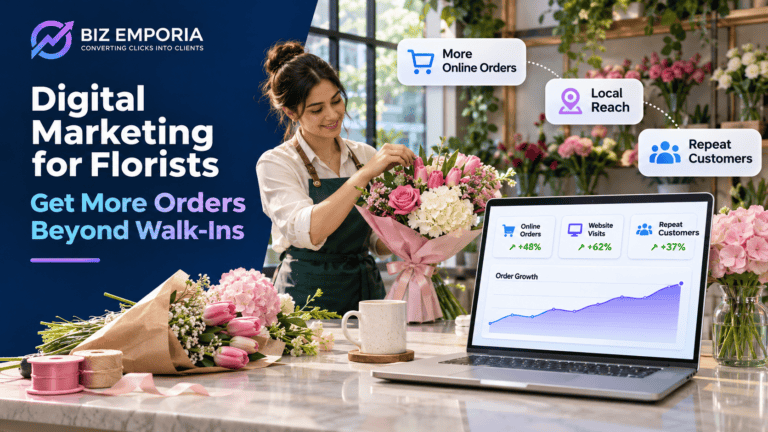
A wet Saturday can empty a flower shop. The cold room is full from the early market run, the buckets are lined up by the door, and the bell goes twice before noon. Stock doesn’t wait for the weather to improve, and the rent doesn’t either.
Walk-ins still matter, and nobody should stop welcoming them. But the florists having steady years right now have built something alongside the shop. A wedding consultation comes in from Instagram. A corporate account enquiry lands from a Google search. Somebody orders sympathy flowers at 11pm because your shop was the first result on their phone.
Digital marketing for florists doesn’t need a big budget. It needs you to pick the channels that matter for flowers and build each one properly, instead of spreading yourself thin across all of them.
Three Customers, Three Different Shops
A florist runs three businesses under one roof. There’s a local retail shop, a premium service for life events, and a supplier to offices. They don’t buy the same way.
Customer | How they decide | Timeline | What they need to see |
Birthday or gift bouquet | Impulse, usually after a scroll | Seconds to minutes | A photo, a price, a delivery slot |
Wedding or event | Weeks of research and comparing | Weeks to months | Real weddings, your style, a consultation process |
Corporate account | Budget holder who wants reliability | Days to weeks | Contract terms, delivery schedule, references |
A florist marketing consultant who lumps these into one audience will serve one and neglect the other two. Most florist advice targets the impulse buyer because social media reaches them easily. The wedding and corporate sides are where the larger, longer relationships come from.
Your Google Business Profile Does the Heavy Lifting
Type “florist near me” or “flower delivery Manchester” into your phone. Before any organic result or ad, three shops appear with photos, ratings and a call button. That box brings in a big share of local enquiries, and your Google Business Profile controls it.
Most florist profiles are half finished. A handful of photos, a few reviews, nothing posted since last Mother’s Day, and categories picked years ago. A strong profile looks different:
- Separate product categories for wedding flowers, sympathy arrangements, corporate flowers and seasonal collections
- 50 or more reviews, with something new in the last 30 days
- Weekly posts around Valentine’s Day, Mother’s Day and Christmas, and one every couple of weeks the rest of the year
- Photos of arrangements you actually made, not supplier images
- Every review answered, and every question too
A shop with 60 recent reviews and a profile that’s clearly alive will outrank a competitor with a nicer website and a neglected listing. Local search rewards activity.
Instagram Pays Off When You Show the Work
Florists have an edge on visual platforms that most industries would pay for. The product is beautiful, arranging looks satisfying on video, and weddings and celebrations hand you emotional material for free.
Product shots on a white background don’t do much. What works:
- A wedding setup filmed from the van arriving at 6am to the finished room
- A time-lapse of a hand-tied bouquet coming together
- Stories answering real questions, like how far ahead to book wedding flowers
- A client’s reaction at an event, with their permission
- Seasonal posts going up two to three weeks before the date
Any florist marketing expert will tell you that last point matters most. A Valentine’s push on February 12th arrives late. Orders from social come from people who saw you weeks earlier, thought “I should remember that”, and acted when the date got close.
A Website With a Page for Every Search
People search for flowers in specific ways. “Wedding florist Leeds.” “Same day flower delivery Leeds.” “Corporate flower subscription Leeds.” “Sympathy flowers Leeds.” Each one is a different buyer with a different budget and a different clock.
One homepage trying to answer all of them loses to separate pages built around each. Part of digital marketing for florists is accepting that a bride and a last-minute buyer want to see different things in the first five seconds.
Page | Search it targets | Must show above the fold |
Wedding flowers | Wedding florist [city] | Recent weddings, how to book, consultation steps |
Same-day delivery | Same day flower delivery [city] | Delivery area, order cutoff time, what’s available today |
Corporate | Corporate flower subscription [city] | Weekly or fortnightly options, how invoicing works |
Sympathy | Sympathy flowers [city] | Calm tone, clear options, how fast you can deliver |
These pages shouldn’t look alike, and none of them should read like generic flower shop copy.
Paid Ads for the Busy Weeks
Paid search is most useful in digital marketing for florists around the dates that bunch demand: Valentine’s Day, Mother’s Day, Christmas and local events. Search volume jumps, and the people searching are ready to order.
A Google Ads campaign starting two to three weeks before each big date, aimed at purchase-intent searches in your delivery or collection area, pays back for shops that can handle the orders. It doesn’t need to run all year. Four or five occasions is a sensible plan for most independents.
The Mistake That Makes Working Channels Look Broken
Most florists judge every channel by the same quick sale. That’s what makes working channels look broken.
Say a future bride finds you on Instagram. She’s forming an impression and isn’t close to enquiring. If she sees an ad with a “book now” button, she’ll scroll past it, the ad will look like a failure, and you’ll blame the channel.
Three weeks later she’s followed the account and seen five more posts. Now she’s researching properly. She searches “wedding florist Leeds” and sends an enquiry. Instagram built the preference, and Google caught the intent at the moment it was ready. Once you treat each channel as a stage in one decision, digital marketing for florists starts behaving like a system, instead of five separate experiments.
What a Florist Marketing Consultant Actually Adds
Most florists do their marketing in the gaps between orders. They post when they remember, fix the website when it breaks, and run an offer when the till goes quiet. The tactics are fine. What’s missing is consistency, which lets each channel build on the last, and it’s the first thing to slip when the shop gets busy.
A florist marketing consultant brings three things that are hard to keep up alone:
- Steady work across every channel, however hectic the week is
- A plan where each channel supports the others
- Reporting that shows which activity produced orders and which just produced impressions
A florist marketing expert also watches the calendar, so Mother’s Day content goes out in time instead of a week late. Working with one at a level that moves results for an independent usually starts around £500 to £1,000 a month, depending on the channels covered. For a shop turning over £150,000 a year or more, that spend almost always pays back inside six months. Below that, start with the profile and a review routine yourself.
Conclusion
Digital marketing for florists works when it follows how buyers actually find and choose a shop. Local search when they need flowers today. Instagram when they’re forming a view about a future occasion. Google when they’re researching something as big as wedding flowers.
Build all three with specific pages and content for each type of buyer, then keep going. A good florist marketing consultant will help you stick with it. That’s how a florist business keeps growing whether or not anyone walks past the window.
If you want digital marketing for florists built around how your own customers find and buy, BizEmporia works with florists and independent retailers to set up marketing that brings steady orders and enquiries. Book a consultation through the website.
frequently Asked Questions
Google Business Profile for local search visibility and walk-in and delivery order capture. Instagram for wedding and event lead generation. Local SEO for long-term organic search traffic. The right priority depends on which revenue stream the business most needs to grow but most florists benefit from building all three simultaneously rather than sequentially.
Three to four weeks before the occasion for social media content and email campaigns. One to two weeks before for paid ads targeting purchase-intent searches. Many florists post Valentine’s Day content on February 11th. The florists winning those orders were posting in late January, building preference before the search intent peaks.
Yes, by competing on dimensions supermarkets cannot match: personalisation, expertise, emotional occasion relevance, and wedding and event capability. Digital marketing for florists should emphasise exactly those differences rather than competing on price or convenience where supermarkets have a structural advantage.
More than the nearest competitor in the same search category. A florist with 60 reviews and consistent recent activity will typically outperform one with 20 reviews and a higher rating. Volume and recency both signal active business health to Google’s local ranking algorithm.
A florist marketing expert with specific experience in floral retail or local service businesses with occasion-driven purchase cycles will produce more relevant strategy than a generalist. The seasonal timing dynamics, the wedding lead nurture requirements, and the visual platform priorities are all specific to florist marketing in ways that benefit from relevant prior experience.