
Google Ads for Florists: What Works, What Wastes Budget, and How to Find the Right Agency
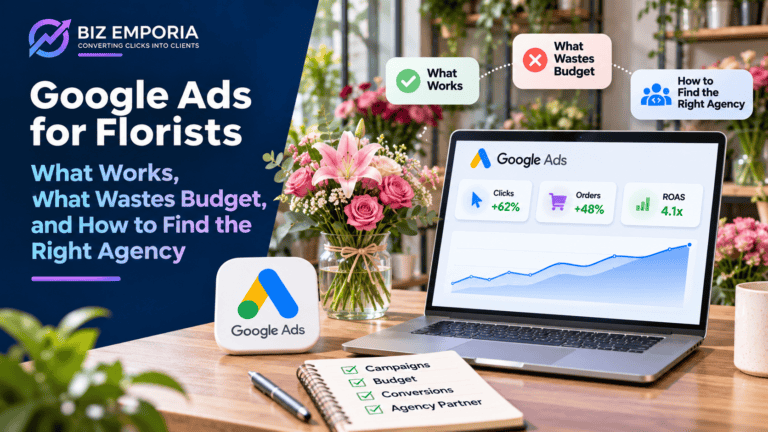
Florists who try Google Ads for three months and quit have nearly always run the same campaign. Generic keywords, the homepage as the landing page, the same budget every week of the year, and no real idea which clicks turned into orders. They spend a few hundred pounds, collect a handful of clicks, see no change in orders, and stop.
Google Ads does work for florists. Independents who set it up properly see it month after month. Valentine’s Day, Mother’s Day, same-day delivery and wedding research are all commercial searches from people ready to spend. When it fails, the cause is how the campaign was built. The channel itself is rarely at fault.
Why most florist campaigns burn through budget
Keywords that attract the wrong clicks
Bid on “flowers” or “bouquets” with loose match types and your ads go to people shopping for artificial flowers, hunting for seeds, looking for pictures for a design project, or sitting in cities you don’t deliver to.
Every irrelevant click costs money. Over a month of broad targeting, the waste can easily outweigh the revenue from the clicks that do convert.
The searches that bring in real orders are specific:
- “florist near me”
- “same day flower delivery [city]”
- “wedding florist [city]”
- “flower delivery [specific area]”
- “sympathy flowers [city]”
Target these with exact or phrase match so your spend lands on searches that convert, and not on ones that only share a few words with what you sell.
Sending ad traffic to the homepage
Someone clicks an ad for same-day delivery in London and lands on a homepage showing wedding, corporate, sympathy and seasonal flowers all at once. They have to hunt for what they came for. Some will keep looking. Plenty won’t.
A dedicated same-day page solves it. Put the delivery area, the cutoff time, today’s products with real prices and a simple order process above the fold. The same click converts at a clearly higher rate, because the page delivers what the ad promised.
No seasonal budget management
A flat budget all year doesn’t suit how florist demand behaves. Search volume jumps in the weeks before Valentine’s Day, Mother’s Day, Christmas and local occasions, then falls away.
A Google Ads agency for florists that knows the work will raise bids and budget in the two weeks before each big date and trim spend in the quiet stretches. Spending the same amount through Valentine’s week and the dead weeks of November is an expensive way to run things.
What a well-built florist campaign looks like
Campaigns that produce steady, profitable orders keep each type of intent in its own campaign.
Campaign | Target query | Landing page | Key metric |
Same-day delivery | Same day flower delivery [city] | Delivery page with availability and cutoff time | Orders placed |
Wedding enquiries | Wedding florist [city], wedding flowers quote | Wedding page with portfolio and enquiry form | Form submissions |
Seasonal occasions | Valentine’s flowers [city], Mother’s Day bouquet | Occasion landing page | Orders in campaign window |
Sympathy flowers | Funeral flowers [city], sympathy arrangement | Sympathy page with suitable tone and options | Enquiries and orders |
Corporate flowers | Corporate flower subscription, office flowers | Corporate page with contract and delivery info | Account enquiries |
Each has its own goal, bidding approach and landing page. Don’t judge a wedding campaign on immediate orders, because those conversions take weeks. Same-day campaigns get judged on same-session orders, since the intent is immediate.
A florist PPC agency that runs all of this out of one campaign can’t tune any of it properly. The success metrics differ, so the bidding logic has to differ too.
The seasonal calendar florists need
Most florist PPC management falls short in the periods that matter most, because campaigns go live too late.
- Valentine’s Day (February 14): Live from January 25. Triple the budget from February 7. Switch the ad copy to urgency from February 11. Pause or cut on February 15.
- Mother’s Day (UK in March, US in May): Live three weeks out. Raise the budget from ten days before. Add delivery cutoff messaging from five days before.
- Christmas: Launch ads from 1 December. Increase spending from 15–22 December, when demand peaks. Promote corporate gifts and gift bouquets from 1–10 December, followed by personal flower orders and delivery.
- Local events: For wedding fairs, corporate events and festivals, prepare campaigns at least two weeks before search activity is expected to pick up.
A PPC agency for florists with no calendar like this built into its process will keep missing the peak windows, which is where the return is highest.
Choosing a Google Ads agency for florists
Picking the right Google Ads agency for florists is harder than it sounds, because every agency describes itself in relevant-sounding language. A few questions cut through it.
Can you show case studies from florists or independent retailers with occasion-driven sales? Seasonal demand, wedding lead nurture, same-day delivery conversion and multi-campaign structures are all particular to flowers. An agency with florist or near-identical experience has met these problems before. Others learn on your money.
How would you structure same-day delivery versus wedding enquiries? The right answer is separate campaigns, each with its own objective, bidding, landing page and metrics. If they propose one campaign for everything, they’re optimising for their own convenience.
How do you adjust for Valentine’s Day and Mother’s Day? Listen for specific bid and budget increases two to three weeks out, urgency copy as the date nears, and cuts afterwards. If they haven’t thought about it, they’re managing ads as though demand never changes.
What conversion tracking do you set up? You want order tracking on same-day campaigns, form tracking on wedding and corporate enquiries, and call tracking for mobile searches. An agency tracking only one of those sees a fraction of the results.
Who manages my account day to day, and how many accounts do they run? The person doing the daily optimisation matters more than the brand name. Someone juggling 40 accounts can’t give yours the attention it needs, so confirm capacity before you sign.
Red flags
- One campaign for every florist service, ignoring buyer intent
- No florist or retail case studies when you ask for them
- Reports full of impressions, reach and clicks instead of orders, enquiries and cost per conversion
- No mention of seasonal campaign management or occasion-based budget changes
- Guaranteed traffic, conversion rates or rankings, which nobody can honestly promise
- A request to create the Google Ads account in the agency’s name
Stop on that last one. In a florist PPC management arrangement where the agency owns the account, ending the relationship means the florist loses all the campaign history, quality score data and conversion tracking built up during the engagement. The florist should always own the account. An agency that insists otherwise is building a dependency that benefits only itself.
The first 90 days
Month 1: infrastructure. Keyword research, campaign structure, negative keyword list, landing page audit and build brief, conversion tracking, call tracking if relevant, and ad copy. Keep spend low until tracking is confirmed, because a big budget with no conversion tracking is running blind.
Month 2: launch and learning. Campaigns go live, search term reports get reviewed weekly, irrelevant queries go onto the negatives list, early landing page data starts coming in and ad copy split tests begin. Expect leads and orders, though not yet at a good cost per conversion.
Month 3: first real optimisation. By now there’s enough data to see which keywords, ads and landing pages perform best. Budget shifts toward the combinations with the lowest cost per order or enquiry. If an occasion falls inside the window, seasonal adjustments apply.
An agency that guarantees big returns in the first week, before completing the groundwork, may be setting unrealistic expectations. A proper campaign needs time for research, setup and testing. This early effort helps build a campaign that can perform well over time.
Conclusion
To get meaningful results from Google Ads, florists need campaigns built around customer searches, from urgent flower deliveries to wedding orders and seasonal bouquets.
Finding a suitable Google Ads agency for florists involves asking about its experience with similar businesses, reviewing its campaign plan and checking how it will manage seasonal demand.
A PPC agency for florists that understands these buying patterns can make better use of the budget than one using the same e-commerce strategy for every business.
BizEmporia works with florists on Google Ads campaigns built around how florist buyers search and order. Book a consultation to see what a properly structured florist PPC campaign looks like for your business.
frequently Asked Questions
A meaningful campaign for an independent florist typically requires £400 to £900 in ad spend per month outside peak seasons, with budget increasing to two to three times that level in the two weeks before Valentine’s Day and Mother’s Day. Management fees are additional. Total investment of £700 to £1,500 per month provides a workable starting range for most independent florists.
Same-day delivery campaigns targeting immediate purchase intent can produce orders within days of going live when the landing page and conversion tracking are set up correctly. Wedding enquiry campaigns take longer because the buyer’s decision process spans weeks. Understanding which campaign type is being evaluated and against what timeline prevents premature judgements about performance.
Different roles, different timelines. Google Ads capture buyers with immediate purchase intent, particularly for same-day delivery and seasonal occasions. Social media builds the preference and familiarity that converts to wedding and event enquiries over weeks or months. Both are worth investing in and they serve different parts of the buyer journey rather than competing for the same conversion.
A separate landing page for each campaign type. A same-day delivery landing page needs the delivery area, cutoff time, and available arrangements visible without scrolling. A wedding enquiry landing page needs portfolio photos, style information, and an enquiry form. The homepage is not a landing page for either of those purposes.
Cost per order for same-day delivery and seasonal campaigns. Cost per qualified enquiry for wedding and corporate campaigns. Call volume attributed to ads for mobile search traffic. Overall return on ad spend during peak season windows. An agency measuring only impressions and clicks is not measuring the outcomes the business cares about.