
Growth Hacking vs Digital Marketing: Which Do You Need?
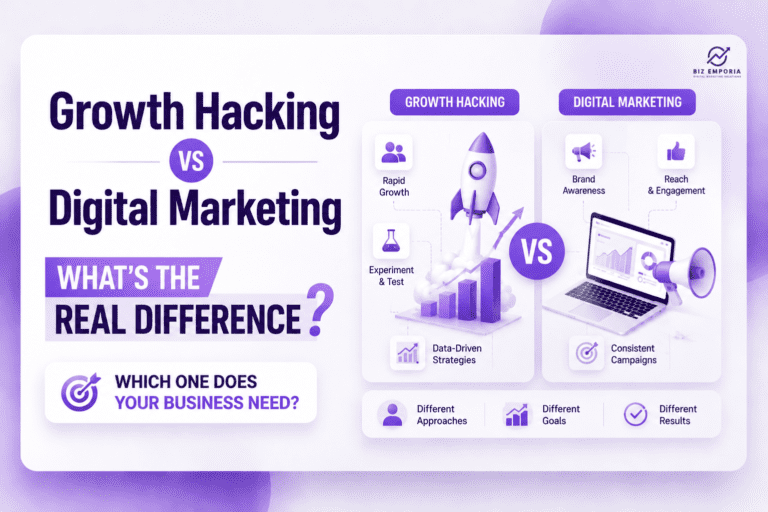
Growth Hacking vs Digital Marketing: What’s the Real Difference (and Which One Does Your Business Need?)
People use these two terms interchangeably. That is the first problem. The second is that the people doing it are usually the ones deciding where the budget goes.
Marketing and growth hacking are not the same thing. One is a long game. The other is a targeted assault on a single number. Mixing them up creates the kind of strategic drift that takes twelve months to notice and another twelve to fix.
What Is Digital Marketing and What Is Growth Hacking?
The distinction between marketing and growth hacking starts with intent, one builds over time, the other attacks a single number fast. Digital marketing covers the full range of online channels that are used to build brand presence and generate demand over time. It includes SEO, paid ads, content, email, social. At its most basic, growth hacking means choosing one number you need to move and throwing short focused experiments at it until something works. The metric is usually acquisition or revenue. The method is whatever actually gets results.
A lot of people hear the word hacking and immediately think of shortcuts or something slightly dodgy. That reaction is understandable but it gets in the way. In this context, hacking has nothing to do with any of that. It is really just describing a particular way of thinking about growth. It is the same instinct an engineer brings to a bug. Form a theory, run the test, read the results honestly, and decide what to do next based on those rather than on gut feel.
Dropbox’s referral programme added 3,900 percent more signups. That is growth hacking. A brand building content that ranks for thousands of commercial terms over years. That is digital marketing. Both are legitimate. Neither is the other.
Growth Hacking vs Digital Marketing: What Actually Separates Them?
Objective and timeframe separate them cleanly. Digital marketing builds infrastructure: audience, trust, organic reach. Growth hacking sacrifices breadth for speed. One metric, fast experiments, kill what does not move it, scale what does. The team composition, budget logic, and risk tolerance are entirely different.
Here is how marketing and growth hacking compare side by side:
Factor | Digital Marketing | Growth Hacking |
Primary goal | Brand building and sustained demand | Moving one metric fast |
Timeframe | Long-term, 6 to 24 months | Short sprints, weeks to months |
Method | Channel strategy and content planning | Test, measure, cut, repeat |
Team | Marketing specialists by channel | Product, dev, data, and marketing combined |
Budget | Planned spend with consistent allocation | Lean, test small, scale only what works |
Risk level | Moderate, brand-safe decisions | High, unconventional tactics are expected |
Best for | Established brands, sustained growth | Startups, pre-scale, inflection points |
One important thing that table does not show: most businesses eventually need both. Just not at the same time, and not in equal proportion.
Which Businesses Need Growth Hacking and Which Need Digital Marketing?
For an early business that is short on resources and needs to show traction fast, growth hacking is probably the right call. For something more established that is playing a longer game and needs consistent pipeline rather than a one time spike, digital marketing is where the investment makes more sense. Most businesses are somewhere in the middle of those two and the honest question is not which one is better but which one the business actually needs more right now.
A SaaS startup chasing 1,000 paying users before a Series A does not need a twelve-month content calendar. It needs growth hacking consulting and fast experiments. A regional law firm building client trust over five years does not need a viral referral loop. It needs SEO and content that positions the firm as the authoritative voice in its practice area.
The mistake is not choosing the wrong tactic. It is choosing the right tactic for the wrong stage. That happens more often than anyone admits.
Signs your business needs growth hacking right now:
- Product-market fit exists but no reliable acquisition channel does yet
- One specific metric is stuck and consistent effort is not moving it
- A launch or funding window has a hard deadline attached
- Budget is tight and you need signal before you can justify scale
Signs your business needs digital marketing as the foundation:
- You are building for the next three years, not the next three months
- Your buyers decide slowly and trust is central to the sale
- Lead flow needs to be predictable, not periodic
- Brand credibility closes deals in your category
Can Growth Hacking and Digital Marketing Work Together?
The two are not in competition. The growth strategies that actually perform tend to use both. Digital marketing builds the infrastructure and growth hacking figures out the fastest way to move through it. Take away the infrastructure and there is nothing worth experimenting on. Take away the experimentation and you are leaving growth on the table that could have come faster.
Growth hacking for brands with existing digital marketing foundations is a completely different exercise than growth hacking from zero. An email list of 20,000 engaged subscribers is a testing ground. A landing page getting 5,000 organic visits monthly is a conversion experiment waiting to run. The two approaches feed each other when sequenced correctly.
Growth hacking vs business development is worth a brief mention because the comparison comes up. Business development is relationship-led and long-cycle. Growth hacking is data-led and short-cycle. They serve different levers. Conflating them leads to underinvesting in one and being frustrated by the other.
Growth hacking business results arrive fastest when there is an existing audience to run experiments on. Digital marketing builds that audience. One lays the track. The other decides the speed.
Conclusion: Same Arena, Different Fights
Marketing and growth hacking belong in the same conversation, not the same sentence. One builds the brand and pipeline over time. The other attacks a specific problem at speed. Using either one in the wrong context wastes resources most businesses cannot afford to replace.
The businesses getting this right know what stage they are at, what metric needs to move, and which approach matches that right now. Not next year. Now.
BizEmporia works with brands and growth-stage businesses to figure out exactly that. Book a consultation through the website. The starting point is an honest look at where the gaps are, not a pitch for a service you may not need yet.
FAQ
Q: Is growth hacking only for tech startups?
That is where the term originated, yes. But the methodology has moved well beyond Silicon Valley. E-commerce brands run growth hacking experiments on checkout flows. Service businesses test referral mechanics. B2B companies run rapid LinkedIn outreach experiments to find the message that converts. The sector does not matter. The stage and the objective do.
Q: Does growth hacking replace the need for digital marketing?
No, and businesses that treat it as a replacement usually find out why within a year. Growth hacking produces spikes. Digital marketing builds floors. A business running only growth hacking experiments grows in bursts and has nothing to fall back on between them. The combination of digital marketing growth hacking is what turns a spike into a sustained trajectory.
Q: When should a business bring in growth hacking consulting?
Three situations: when internal experiments are not moving the number, when a specific growth window has a deadline attached, or when the team is too close to the problem to see the unconventional angles. Growth hacking consulting brings an outside framework and the speed of an iteration cycle that most internal teams cannot maintain while running everything else.