
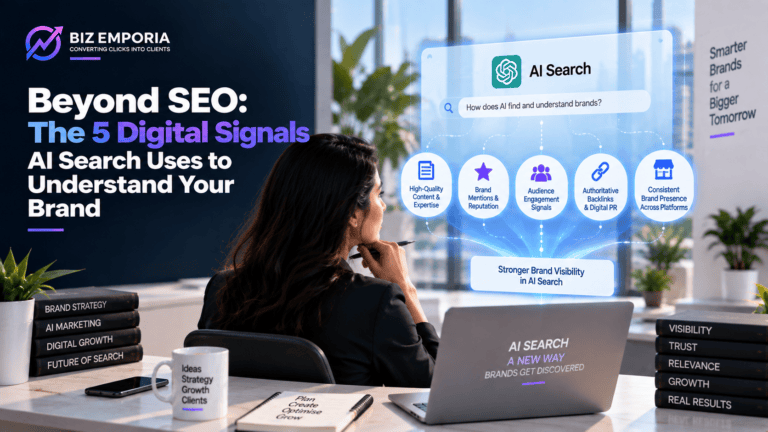
Beyond SEO: The 5 Digital Signals AI Search Uses to Understand Your Brand
For fifteen years, the game was clear. Produce content, earn backlinks, fix the technical issues, and the rankings follow. The rules were not always fair but at least they were consistent.
AI search signals work differently. Google’s AI Overviews, ChatGPT, Perplexity, and Gemini do not rank ten pages and let the user pick. They synthesise an answer and either include your brand in it or they do not. The decision happens before the user sees anything. And the factors driving that decision are not identical to the ones that drove traditional SEO rankings.
Most brands have not figured this out yet. Their SEO is fine. Their AI brand visibility is close to zero. Those two things can absolutely coexist, and they do, for most brands right now.
These five signals influence whether an AI system understands your brand, sees it as trustworthy, and includes it in the answers it gives to buyers in your category.
Signal 1: Content That Answers Specific Questions, Not Content That Targets Keywords
Traditional SEO rewarded content for using the right keywords at the right density. AI search signals place more value on content that fully and clearly answers a specific question in a format AI systems can extract and use on its own. That difference matters more than it may seem.
If a piece of content takes several paragraphs before getting to the actual answer, an AI model may struggle to extract the information it needs. Put the specific answer first, then follow it with evidence, context, and supporting detail. That structure makes the content easier to extract and cite.
Think about how ChatGPT or Perplexity actually generates an answer. It reads across a body of content, identifies sections that directly address the query, pulls those sections, and synthesises them into a response. Content that is written for a human reader to enjoy from start to finish behaves differently in that extraction process than content structured with the extractable answer at the front.
Practically, this means every piece of content worth producing needs to answer one specific question directly and answer it better than anything else currently online on that question. Not broader. Not more comprehensive in a general sense. More specific, more accurate, and more directly useful to the person asking.
The brands building AI brand visibility through content today are asking a simple question: what is my buyer actually typing into ChatGPT, and does our content answer it in a way an AI system can extract and use? The ones still producing keyword-stuffed general overviews are producing content that feeds AI models the information while getting no credit for providing it.
Signal 2: Authority From Sources the AI Actually Trusts
Backlinks built Google’s authority model. AI search signals for authority work differently and the difference is important enough to change where brands invest their off-site efforts.
AI models build their sense of a brand’s authority from what credible sources say about it across the web. Not from how many websites link to it. From what specific sources say, in what context, with what specificity.
A mention of your brand in a well-regarded industry publication that describes what you do, who you serve, and what outcome you produce is a stronger AI search signals input than a hundred generic directory listings with your company name and URL.
The categories of sources that carry genuine weight with AI systems:
Industry publications that cover your category in depth. When a respected trade publication in your sector cites your brand as a relevant option, an expert, or a reference point, AI models learn from that citation. The brand becomes associated with the category, the problem, and the context in which the publication mentioned it.
Analyst and research organisations. G2, Gartner, Forrester, and equivalent sector-specific research organisations are heavily indexed by AI models. A brand that appears in analyst coverage, review aggregators, and research reports becomes part of the answer AI generates when buyers ask which brands are relevant in a category.
Professional communities and forums. Niche forums, LinkedIn discussions, Reddit threads in relevant subreddits, and professional community platforms where practitioners discuss tools and services are all indexed by AI models and influence what those models understand about a brand’s reputation among the people who actually use it.
Expert and practitioner endorsements. A named expert in your field writing specifically about your brand’s approach or results carries more weight than a press release or a generic mention. The specificity is the signal. AI models extract specific, attributable claims. Vague endorsements do not extract cleanly.
At the authority level, generative engine optimization means building a deliberate presence in the sources AI systems trust, rather than focusing only on sources that generate backlinks for traditional SEO.
Signal 3: Brand Consistency Across Every Digital Surface
AI models do not evaluate a brand from a single source. They build a composite understanding from everything they have indexed about it. When a brand’s description, claims, audience, and reported results vary from one source to another, AI systems can end up with a fragmented view of the business. That uncertainty can make them more cautious about citing the brand or lead them to cite it with less confidence.
AI search signals related to brand consistency cover several dimensions.
Name and description consistency. If the brand describes itself as a “B2B SaaS platform” on its website, a “sales automation tool” on G2, a “CRM for small businesses” in press releases, and a “revenue operations platform” in analyst briefings, an AI model trying to understand what the brand does encounters four different answers. The result is either a confused composite or the AI choosing a more consistently described competitor.
Claim consistency. The results and outcomes the brand claims should be consistent across all touchpoints. Wildly different claims in different contexts, “we save teams 10 hours a week” on the website but “we reduce operational costs by 40 percent” in a case study and “the leading platform for revenue teams” in a press release, produce a composite that is hard to cite accurately. AI models cite specific, consistent claims. Inconsistent claims get averaged out into vagueness.
Visual and tonal consistency matters less to AI than textual consistency, but the two tend to correlate. Brands that have done the work of making their positioning consistent across channels tend to have done the textual consistency work too. Brands that have not done the positioning work tend to be inconsistent in both dimensions.
For AI brand visibility, the practical exercise is to search for your brand across the sources AI systems index and read what each one says. Do they tell a consistent story? Does the composite picture that emerges from those sources describe the brand you actually are and the customers you actually serve? If not, the inconsistency is a generative engine optimization problem with a specific fix: updating the sources that are inconsistent rather than just the website.
Signal 4: Online Mentions With Specific Context
Volume of mentions used to matter. In AI search signals, the specificity of those mentions matters considerably more.
A high volume of generic brand mentions across directories, syndicated press releases, and thin review platforms may establish your presence, but it does not give AI much context. Fewer mentions in relevant sources, when they explain what you do, who you help, and what you achieve, provide far more useful information for generating accurate responses.
The specificity dimensions that matter:
What problem does the brand solve? Mentions that describe the specific problem the brand addresses in the same language buyers use are the mentions that influence AI responses when buyers ask about that problem.
Who uses the brand? Mentions that identify the specific type of customer, company size, industry, or role are more useful to an AI generating a response for a buyer who has described themselves in similar terms.
What outcomes does it produce? Specific outcome mentions, “reduced reporting time from 14 hours to 3 hours,” “helped the team close 30 percent more pipeline in the first quarter,” carry more weight than generic benefit claims. The specificity is extractable. The generics are not.
Building this signal means actively shaping the context in which the brand is mentioned across the web. Case studies with specific numbers published on credible platforms. Client stories told with enough detail that an AI model can extract relevant specifics. Contributions to industry discussions where the brand’s specific approach is described rather than just its name dropped.
AI search signals from online mentions are not something that happen to a brand. They are something a brand builds deliberately by ensuring that the most specific, accurate, and useful descriptions of what it does are present in the sources AI models index most heavily.
Signal 5: User Interaction Patterns That Confirm Brand Relevance
AI models are not static. They learn from patterns of user behaviour, including how users interact with content, whether users follow up AI-generated recommendations with direct brand searches, and whether the brands recommended by AI in a given context tend to satisfy the intent behind the query.
Of the five AI search signals, this one is the most indirect. It is still important because it helps explain why the other four can strengthen each other over time rather than creating only a temporary lift.
When users act on an AI-generated brand recommendation, explore the site, and find what they came for, their behaviour provides a signal that the recommendation was relevant to their query. Brands whose AI recommendations consistently produce satisfied users accumulate a positive relevance signal over time. Brands whose recommendations lead to quick exits and return visits to the AI for further help accumulate the opposite.
The practical implication is that the post-click experience matters for AI brand visibility in a way that has no direct equivalent in traditional SEO. A brand that is cited by AI but whose landing page does not deliver on the specificity of the recommendation being made is not just losing a conversion. It is providing a negative relevance signal that influences future citation decisions.
What this means for brands investing in generative engine optimization: the landing experience that receives AI-referred traffic needs to be built specifically for a user who arrived with a high-context, specific intent rather than a generic product page built for all visitors equally. The user who clicked from an AI recommendation knows more about what they are looking for than the average visitor. The page they land on should reflect that.
How These Five Signals Work Together
These signals are not independent. They reinforce each other in ways that compound the advantage for brands that build all five and compound the disadvantage for brands that ignore them.
Specific, well-structured content earns citations from credible sources. Citations from credible sources build authority signals. Authority signals make future content citations more likely. Brand consistency makes those citations coherent and useful for AI response generation. Specific online mentions in the right contexts fill the gaps that on-site content does not cover. Positive user interaction patterns confirm that the citations are producing relevant recommendations.
The brands that are hardest to displace in AI-generated answers in twelve months are the ones building all five signals now, while most of their competitors are still focused entirely on traditional SEO. The window to build that lead is open. It will not stay open at the same cost indefinitely.
BizEmporia audits and builds AI search signals for brands across India, UAE, UK, and international markets through its GEO and LLM Ads services. If your brand is not appearing in AI-generated answers for the questions your buyers are asking, start with a free AI brand visibility audit. Book through the website or write to info@bizemporia.in.
frequently Asked Questions
On-site content changes that improve answer-specificity can start influencing AI citations within four to eight weeks. Off-site authority building through relevant publication mentions and analyst coverage takes three to six months to accumulate meaningfully. Brand consistency work produces results faster because it is correcting existing signals rather than building new ones. The full compound effect of all five signals working together is typically visible at the six to twelve month mark.
Content structure almost always comes first because it is entirely within the brand's control and the changes can be made immediately. A brand whose content does not answer specific questions in an extractable format will not benefit much from the other signals even if they are strong. Fix the content layer first. Then build the authority and mentions layer around it.
Yes. Traditional SEO and AI search signals share a significant number of underlying quality signals: genuine expertise, accurate information, credible sources, clean site structure. A brand that has done strong traditional SEO has a head start on building AI visibility because the content quality and authority foundation is already partially in place. The additional work is restructuring content for extractability and building presence in AI-indexed sources.
The primary measurement method is manual and systematic: identifying the ten to fifteen questions your buyers are most likely to ask AI platforms in your category, testing those queries across ChatGPT, Perplexity, and Gemini regularly, and tracking whether and how your brand appears in the responses. AI share of voice tracking tools are emerging that automate parts of this process. The baseline measurement should happen before any changes are made so that the impact of each change can be isolated.
Better than on traditional SEO in most cases. AI models weight specificity and relevance more heavily than domain authority and content volume. A small brand that produces ten highly specific, well-structured pieces of content addressing exactly the questions its buyers are asking can outperform a large brand with hundreds of generic articles in AI citation patterns. The playing field is not level but it is more level than traditional SEO, and the early-mover advantage of building these signals now while large brands are still focused on legacy SEO is real.