
Why Your Website Needs to Be AI-Readable, Not Just SEO-Friendly
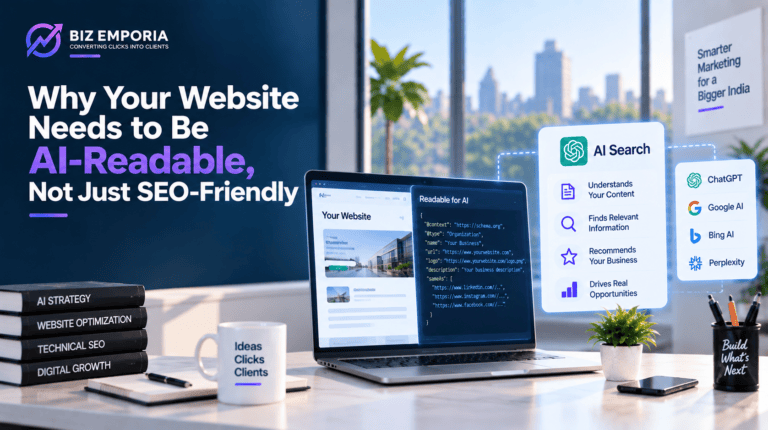
A brand built a website Google loved. Three years of work. Strong content, clean architecture, decent backlinks, consistent organic traffic. Then someone on the marketing team typed a few questions into ChatGPT that their buyers would realistically ask.
The brand did not come up once.
Not in a minor way. Completely absent. Competitors with weaker SEO were being recommended. The brand ranking above them on Google was invisible in the AI response entirely.
The website was not broken. It just was not built for this. Every part of the website had been optimised for the ranking principles search engines used in 2022. What had not been considered was whether an AI system could understand the content, extract something useful, and include the brand in its answers.
That gap is now a business problem.
What Does AI-Readable Actually Mean?
An AI-readable website is neither a technical certification nor a formal standard. The term simply refers to whether an AI system can scan the site, identify clear and specific information, and extract answers to users’ questions.
Here is why the distinction matters. Google ranks pages. AI systems extract fragments. When a user asks ChatGPT a question, the model does not return a ranked list of pages for the user to evaluate. It generates an answer by pulling fragments from content it has indexed and synthesising them into a response. The content that gets pulled is content that delivers a clear, specific answer in a form that can be extracted cleanly. The content that gets passed over is content that buries the useful information inside narrative prose that was written for a human reader to enjoy from start to finish.
A page can rank number one on Google and be completely useless to an AI model at the same time. Ranking means the algorithm judged the page relevant. AI-readable means the content is structured so the answer can be found, extracted, and used without the AI having to read five paragraphs first to find it.
Most websites are the first. Almost none are the second. That is the size of the opportunity right now for brands willing to do the structural work.
Why SEO Got Websites Halfway There and No Further
The standard SEO content structure is actually a reasonable starting point for AI search optimization. Headings that label sections. Logical flow from one topic to the next. Clear paragraph breaks. These things help AI models navigate a page the same way they help a human reader.
Where it stops working is in what sits under those headings.
SEO content is written to engage. It builds context. It tells a story. It works toward its conclusion over several paragraphs so the reader stays on the page. Good editorial instincts, genuinely. The problem is that an AI model scanning for the answer to a specific question is not reading the article. It is looking for the answer. Content that takes four paragraphs to arrive at the answer is content the AI skims, finds nothing cleanly extractable, and moves past.
The adjustment required is one that feels wrong when you first make it. Put the answer at the top. First sentence. Not context, not setup, not a gentle introduction to the topic. The answer. Everything after it is elaboration that serves the human reader who wants depth. But the AI has already found what it needed in sentence one and that is what gets cited.
This is not a small tweak. It is a different way of writing content entirely. Most content teams have never been briefed to do it this way because nobody was asking them to write for AI extraction two years ago. Now somebody should be.
Five Things That Make a Website Actually AI-Readable
Rewrite introductions so the answer comes first
Walk through any business website right now and the pattern is almost universal. Every page opens with a sentence that explains what the page is going to tell you rather than telling you. “In this article we explore the importance of X.” “Understanding Y is crucial for businesses looking to Z.”
Neither of those sentences says anything. They are throat-clearing dressed up as content.
An AI-readable website opens every section with the answer to the question that section is addressing. Not context. The answer. A buyer asks “what does this service do” and the first sentence of the service page answers that question directly. A buyer asks “how does this work” and the how it works section opens with a direct explanation, not with “great question, let me walk you through our process.”
The shift feels abrupt when you first make it. That is usually a sign it is working.
Use schema markup so AI systems know what they are reading
Schema markup is structured data that explicitly identifies what content represents. FAQ schema signals that a page contains organised questions and answers. Organisation schema identifies the brand, what it does, and the category it operates in. Article schema identifies editorial content. Product schema describes offerings with specific attributes.
Without schema, an AI model infers the content type from context. With schema, the content type is stated directly. Inference is slower and less reliable than explicit labelling. For website structure for AI, schema markup is one of the highest-return technical changes available because it removes guesswork from how AI systems categorise and extract content.
Schema is still missing from many business websites, while others have only the basic markup they added years ago. Updating it across service pages, FAQ sections, and blog content can be a one-time technical improvement that makes the site easier for AI systems to interpret.
Make every claim specific enough to be citable
Generic claims do not get cited. They get skipped. “We help businesses grow faster” is a sentence that carries no information an AI model can extract and use in a response. It is too vague to mean anything and too common to be attributable.
A specific claim is a different thing entirely. “Clients reduced their average deal cycle from 47 days to 29 days in the first quarter” contains a before number, an after number, and a timeframe. An AI model can extract that sentence and cite it accurately. The specificity is what makes it citable.
Every claim on the website needs to pass one test: can this be made more specific? If yes, make it more specific. If no because there is no data behind it, either collect the data or remove the claim. The process of asking this question about every page on the site tends to reveal that most of what business websites say about themselves is closer to aspiration than evidence.
Organise content around questions rather than topics
Most website navigation is organised by topic. Services. About. Resources. Insights. These labels tell visitors which area of the site they are in but they do not tell an AI model what questions the content is answering.
Website structure for AI organises content around the specific questions buyers ask. Not “Services” but “What does this service do and who is it for.” Not “Our Approach” but “How does this agency work differently from others.” Not “Case Studies” but “What results have clients seen and in what timeframe.”
The question format is a structural signal. It tells an AI model that the content under this heading is intended to answer that question. The model uses that signal when deciding what to extract. A page structured around explicit questions and direct answers is significantly easier for an AI to use than a page built around topic categories with prose buried inside them.
Build depth around two or three specific subjects
An AI model builds a sense of which brands know what through the consistency, depth, and specificity of what it has indexed about them. A brand with one article on a topic looks different to an AI than a brand with twelve interconnected pieces covering the same topic from multiple angles with consistent, specific, accurate content throughout.
This is topical authority and it matters for AI search optimization considerably. The difference from traditional SEO is that AI models weight the specificity and interconnection of content more heavily than coverage of keywords across a broad range of topics.
Pick two or three subject areas where the brand genuinely has expertise. Produce multiple pieces addressing different specific questions within each area. Connect them so an AI model navigating the site can build a coherent picture of what the brand actually knows. A brand that goes deep on two subjects outperforms a brand that goes shallow on twenty, every time, in AI citation patterns.
What Happens When You Actually Do This Work
The obvious benefit is more frequent citation in AI-generated answers. Brand appears where it was not appearing. Buyers in the research phase encounter the brand in the AI responses they are reading before they narrow down their options. That is the direct outcome.
But there are secondary outcomes worth naming because they affect the business regardless of AI.
Content structured for extractability is also content that human readers navigate faster. The answer-first structure works for a busy professional scanning for specific information just as well as it works for an AI model. Most businesses that restructure content this way see conversion rate improvements on those pages within a few weeks because readers find what they came for without having to work for it.
The specificity required for AI-readable claims pushes brands to quantify their outcomes properly. Asking “can we make this claim specific” reveals either that the data exists and was never used, or that it does not exist and needs to be collected. Both revelations are useful. The website gets better and the brand’s understanding of its own commercial impact gets sharper.
The question-based content organisation naturally aligns with the queries buyers type into search, which means the AI search optimization work tends to improve traditional SEO performance on long-tail queries simultaneously. The two approaches are not in conflict. The AI readability work reinforces what good SEO was always trying to do.
Biz Emporia audits and rebuilds websites for AI-readable website performance as part of its GEO and AI visibility services for brands across India, UAE, UK, and international markets. If your website ranks on Google but disappears in AI-generated answers, the starting point is a free AI visibility audit. Book through the website or write to info@bizemporia.in.
frequently Asked Questions
The structural changes that improve AI readability, direct answers under headings, specific claims, question-based organisation, schema markup, topical depth, all align with what Google's quality algorithms have been rewarding consistently for the last three years. There is no real conflict here. The content quality improvements serve both. Brands that have made these changes have not seen ranking drops. Several have seen improvements on question-based and long-tail queries where the content became more directly useful.
The pages that answer the questions buyers ask most often in the category. For most businesses that means service pages and any FAQ content currently on the site. These are the pages most likely to be relevant to AI queries and the ones where improvement produces the fastest return. Start there. Blog content and secondary pages come after.
Type the questions your buyers would ask into ChatGPT, Perplexity, and Gemini directly. See what comes back. Check whether your brand appears and in what context. Run the same test before any changes are made so there is a baseline to compare against. Run it again four weeks after changes go live. The improvement, when it happens, is visible in the responses rather than in a metric dashboard, which feels unfamiliar but is the most direct form of measurement available.
For a business website with 20 to 30 pages, four to six weeks with focused resource. Prioritising the highest-intent pages means the most important ones can be addressed in the first two to three weeks. Schema markup implementation runs in parallel and does not depend on content rewrites being completed first.
More effectively than through traditional SEO in many cases. AI models weight specificity and direct relevance heavily. A small business answering one specific question better than a large brand with broader, less extractable content gets cited in preference to the large brand for that specific question. The advantage large brands have in traditional SEO, domain authority, link volume, content scale, matters less in AI citation patterns than it does in ranking algorithms. That makes the AI readability work disproportionately valuable for smaller, more focused brands.