
From Google Search to AI Answers: Where Should Your SEO Strategy Focus Now?
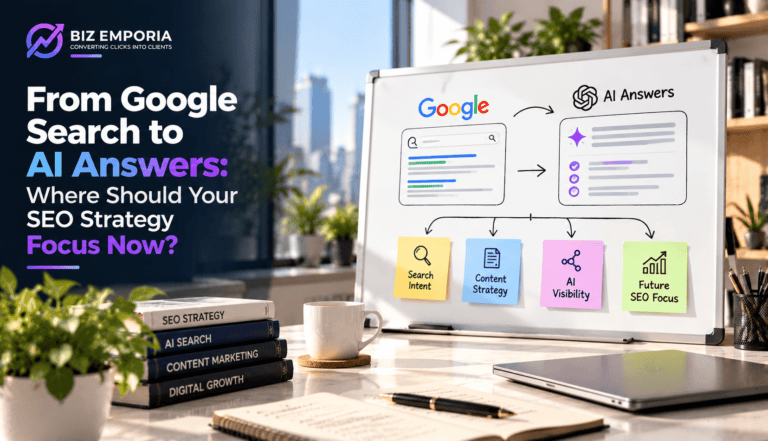
A company might have held strong Google rankings for the past three years and still be missing from a large part of its buyers’ research process. The problem is not necessarily its SEO performance on Google. It is that search behaviour has expanded, while many SEO strategies have not expanded with it.
The shift isn’t that Google stopped mattering. It hasn’t. The shift is that Google’s no longer the only place search intent actually lands. More of your buyers’ research is now happening before they ever contact a company, and some of that research takes place in ChatGPT, Perplexity, Gemini, and Google’s AI Overview. Getting visibility on these platforms does not work in quite the same way as ranking in Google’s traditional organic results.
Search engine optimization services in 2026 need to cover both surfaces, or they’re only addressing part of where buyers are actually looking.
Why Google Rankings Alone Aren’t Enough Anymore
Something specific has been happening to organic click-through rates over the last year and a half that a lot of businesses haven’t quite connected to a cause yet. Rankings are holding steady. Traffic is dropping anyway. Those two facts feel contradictory, and for most of Google’s history, they would have been.
AI Overviews explain it. A page sitting in position one for an informational query is now competing with an AI-generated summary sitting above position one, answering the query directly, and giving a sizeable chunk of users everything they needed without a single click.
For businesses whose search engine optimization services spend went mostly toward ranking informational content, this is a structural problem with a specific cause. It needs a specific response, not just more of the same SEO work piled on top.
On the B2B side specifically, this research shift cuts even deeper. B2B buyers do a lot of digging before they ever contact a vendor, and that process used to run almost entirely through Google, search a query, read a result, search a related query, read another, slowly build a picture of the options across several sessions.
That process increasingly starts with AI instead. Instead of searching through multiple websites, a procurement manager may ask ChatGPT to suggest software options according to the business need. A marketing director might use Perplexity to ask the right questions to ask when choosing an agency. A founder looking for compliance support may explain their company’s size, growth stage, and location, then ask which kind of provider makes the most sense.
Every one of those research sessions happens whether or not your brand shows up in it. A business that’s invested heavily in search engine optimization for b2b targeting through Google keywords might not appear anywhere in the AI-generated answers those same buyers are now getting instead.
What Search Engine Optimization Services Should Actually Cover in 2026
The adaptation here isn’t about replacing traditional SEO with AI optimisation. It’s about expanding search engine optimization services to cover both surfaces, with a real understanding of what each one demands.
Optimisation Type | Primary Surface | What It Involves |
Traditional SEO | Google organic results | Keywords, backlinks, technical site health, content quality |
AEO (Answer Engine Optimisation) | AI Overviews, ChatGPT, Perplexity | Direct-answer content structure, schema markup, specific claim formatting |
GEO (Generative Engine Optimisation) | All AI platforms | Off-site authority building, brand consistency, practitioner-authored content |
Local SEO | Google Maps, local search | Google Business Profile, local citations, location-specific content |
Paid AI placement (LLM Ads) | ChatGPT, Perplexity, Gemini | Sponsored recommendations inside AI-generated answers |
A business investing in search engine optimization services that only covers the first row of that table is really only investing in visibility on one surface of a search environment that now has several. The other rows are where an increasing share of early-stage buyer research is actually happening.
The Content Rewrite That Actually Serves Both Surfaces
The most practical adaptation for search engine optimization for b2b in 2026 is rewriting how content gets structured, such that traditional ranking and AI extraction can work at the same time.
Traditional SEO content is usually written for a human reader, building context before getting to the conclusion, letting the narrative unfold, and bringing in evidence along the way. That works well for someone who is going to read the article from beginning to end. But an AI model may be looking for one particular answer it can pull from the page and use in a generated response.
Content that serves both needs opens every section with the direct answer first, then explains later on. The direct answer is the piece an AI model actually takes out. The explanation is for the human reader who wants more depth. Written this way, the same piece can rank well on Google while also handing AI systems exactly the extractable part they’re looking for.
A few practical things worth doing here: write every section heading as a question your target buyer would genuinely ask. Answer that question directly in the first sentence or two right under the heading. Use specific numbers, timeframes, and client types in your claims instead of vague assertions. Give case studies real before-and-after metrics rather than fuzzy outcome descriptions. And make author credentials visible and specific, especially for content in categories Google treats as requiring real expertise.
That last point ties straight back to E-E-A-T, Google’s framework for judging Experience, Expertise, Authoritativeness, and Trustworthiness. A b2b marketing agency publishing content under named practitioners with demonstrable expertise in the subject will see that content treated differently, by both Google and AI systems, than anonymous content covering the exact same ground.
Where a B2B Marketing Agency Actually Fits Into This
For a b2b marketing agency managing search strategy on behalf of clients, this shift calls for a real expansion in capability, not just a new slide in the pitch deck.
The agencies genuinely delivering value here are doing three things that agencies still running on a purely traditional SEO model simply aren’t.
They’re auditing AI visibility right alongside Google visibility. Any search engine optimization services engagement worth running in 2026 should start by testing how the client’s brand currently appears in AI-generated answers for the exact queries their buyers are asking. That test alone usually reveals either a gap or a relative strength that ends up shaping the whole strategy that follows.
They’re building off-site authority specifically in AI-indexed sources. Traditional link building went after sites for domain authority signals. AI-targeted authority building goes after the specific sources AI systems actually draw from, industry publications, analyst platforms, review aggregators, and the forums where a client’s target buyers actually talk about their category. Different sources, and a genuinely different kind of presence required.
They’re restructuring existing content for extractability. A large chunk of the content on most B2B websites reads well for a human but is structured poorly for AI extraction. A b2b marketing agency with real AI search capability finds the highest-value pages first and rebuilds them to serve both purposes without losing the readability that already performs well in traditional search.
A Framework for Deciding What to Fix First
Not every page and query deserves the same urgency here. Prioritising where to focus means weighing each part of the search strategy against two things, current exposure to AI absorption, and current commercial value of the traffic.
High value, high exposure sits at the top of the list, informational content that was driving real traffic to high-intent landing pages. This gets immediate priority for restructuring and AI visibility work. High value, low exposure covers transactional and local pages where a visitor needs to actually do something specific, these should be protected and maintained through conversion work and local SEO, with less urgency on AI restructuring. Lower value, high exposure means general informational blog content that drove awareness but never converted directly, worth assessing on a case by case basis rather than assuming it’s a priority. Lower value, low exposure, about pages, team pages, secondary service descriptions, sits at the bottom of the list for AI adaptation work entirely.
Businesses handling this transition well aren’t the ones trying to overhaul everything at once. They’re the ones running each part of their search strategy through this framework and adapting in priority order, which means they actually see commercial return on the work before committing the full budget to it.
The Bottom Line
The question of where search engine optimization services should focus now doesn’t have an answer that abandons Google. It has an answer that expands past Google, to cover the surfaces where search intent is increasingly landing instead.
Search engine optimization for b2b in 2026 means ranking well in traditional search while also building the visibility and extractability signals that earn presence in AI-generated answers. Both matter. Neither one alone gets the job done. Businesses treating these as competing priorities, rather than complementary ones, will underinvest in whichever one loses, and pay for it with real visibility gaps down the line.
A well-structured b2b marketing agency with genuine AI search capability can map out exactly where a specific business’s exposure sits, prioritise the adaptation work sensibly, and build the kind of expanded visibility a multi-surface search environment now demands.
If your business needs a clear picture of where your current search strategy is exposed to the AI shift and what adapting it would actually involve, BizEmporia provides search strategy audits and search engine optimization services covering both traditional and AI-powered search for businesses across India, UAE, UK, and international markets. Book a consultation through the website.
frequently Asked Questions
No. Google rankings still produce significant traffic and leads for most businesses, and walking away from that investment means sacrificing real visibility without yet having AI visibility infrastructure built to replace it. The right move is expanding search engine optimization services to cover both surfaces rather than picking one over the other.
The core technical foundations stay the same. What changes is how content gets structured, which off-site sources get targeted for authority building, and how success gets measured. Content needs restructuring for AI extractability alongside human readability. Authority building needs to target AI-indexed sources alongside the usual link-building targets. Measurement needs to include AI share of voice alongside traditional ranking and traffic numbers.
Audit its AI visibility directly. Test the ten questions an ideal buyer would actually ask ChatGPT, Perplexity, and Google's AI Overview, and check whether the brand shows up. The gap between current Google ranking and current AI visibility is what reveals where the most urgent work actually sits.
B2B buyers do far more extensive research before ever making contact, and that research increasingly starts inside AI tools rather than a search bar. The queries B2B buyers put to AI are more complex and situational than typical consumer searches. Search engine optimization for b2b in this context means building content that addresses complex, multi-stage buyer situations, not just simple keyword matches.
By diagnosing the actual cause before recommending anything. Declining traffic on pages with stable rankings is almost always AI Overview absorption hitting informational content. Declining traffic from an actual ranking drop needs a completely different fix. The diagnosis is what determines the right response, and a b2b marketing agency that skips straight to a generic solution isn't really serving the client's actual situation.